
 EN
EN

Why Can a Lightweight Aluminum Tank Increase Useful Payload?
A lighter tank can give a liquid-haul operator more room inside a legal weight limit, but it is not a shortcut around engineering, axle loading, or product-density limits. For an aluminum tank truck, the useful payload question starts with a simple mass balance: legal gross vehicle weight minus the truck, tank body, running gear, safety equipment, driver, and fuel. If a properly designed aluminum tank body weighs less than an equivalent alternative, some of that saved tare mass may be available for carried product.
From a fleet-procurement perspective, the important word is may. A lightweight tanker must still suit its liquid, route, loading routine, and local regulations. The relevant technical question is whether the whole configuration—not only the aluminum tank—fits the duty cycle.
Useful payload begins with tare mass
Useful payload is the mass of product that can be carried after the vehicle’s empty operating mass is deducted from the applicable legal and technical limit. A simplified calculation is:
Useful payload = permitted gross combination or vehicle mass − ready-to-operate tare mass.
Ready-to-operate tare mass includes more than the shell. It can include the chassis, tank, subframe, pump or piping, compartments, walkways, ladders, valves, hose reels, fire equipment, fluids, and optional accessories. Therefore, an aluminum tank does not create extra tanker capacity by itself. It reduces mass only if the completed system is genuinely lighter after the wall thickness, baffles, reinforcements, mounting, and equipment required for the job are accounted for.
That distinction matters when comparing an aluminum tank truck with a heavier material option. A lower tare mass can create legal payload headroom, whereas a larger nominal volume can be unusable if the liquid’s mass reaches a gross or axle limit first.
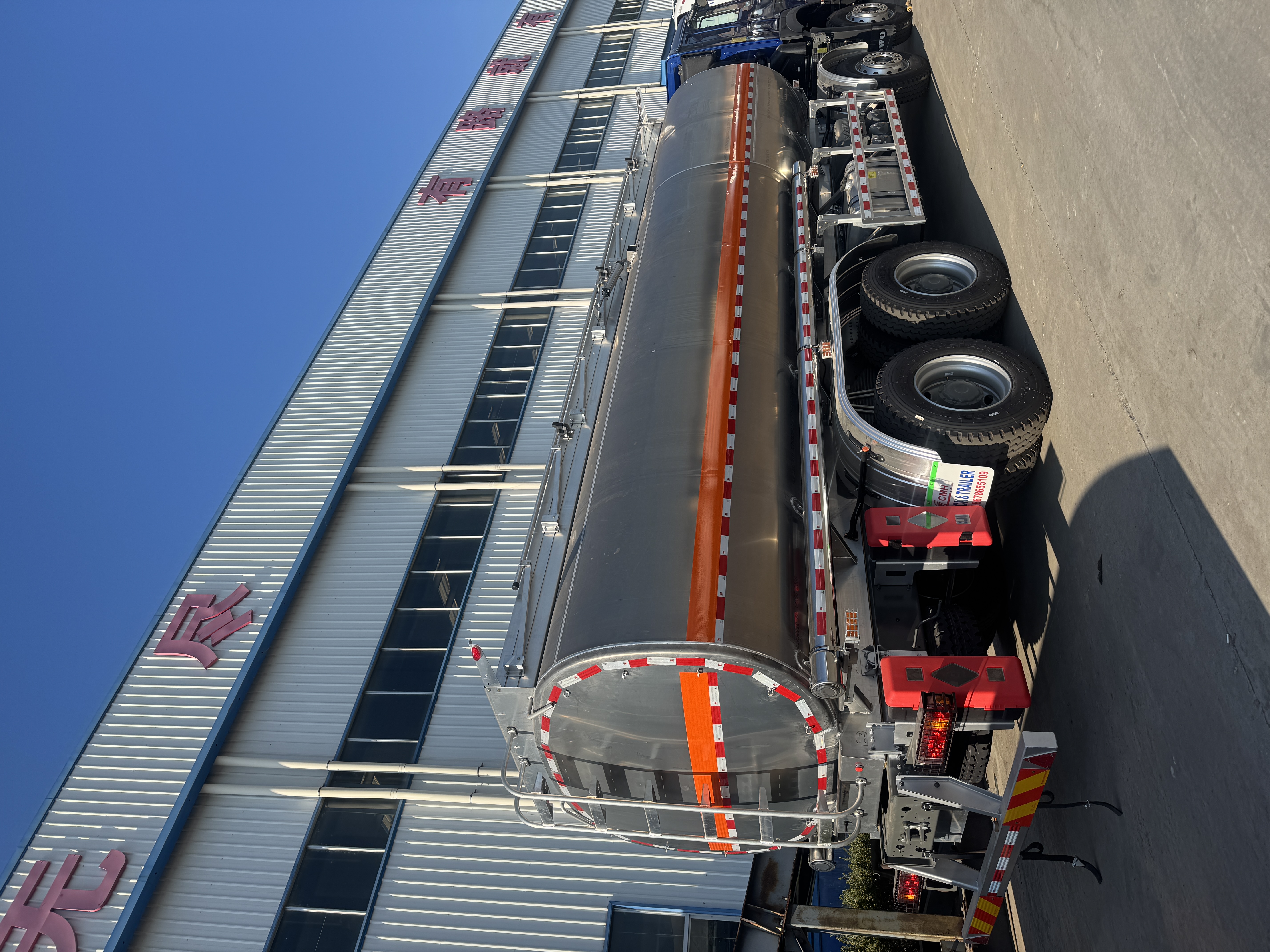
Why aluminum can reduce the empty mass
Engineering density tables commonly place aluminum near 2,700 kg/m³ and mild steel near 7,850 kg/m³. The same volume of aluminum therefore has much less mass than the same volume of steel. Finished tanks are not identical-volume parts, however: aluminum’s strength, stiffness, weld design, fatigue requirements, and applicable codes can require different thicknesses and structural details. A sound comparison is a finished-tank comparison, not a density-table comparison.
For a lightweight tanker, the potential benefit is practical: every verified kilogram removed from the truck’s operating mass can be considered when planning the cargo allowance. The final benefit depends on the actual build specification and the route’s legal limits. It is not simply a material issue; more precisely, the tank design and regulatory limit both matter.
When the weight saving becomes useful payload
Weight savings become useful payload only when weight is the active constraint. Consider two simplified cases:
- Weight-limited operation: A water or other dense-liquid load reaches the legal gross or axle threshold before the tank is full. Lower tare mass may allow additional product mass, provided axle distribution and all applicable limits remain compliant.
- Volume-limited operation: A lower-density liquid fills every approved compartment before the vehicle reaches its weight allowance. In this case, a lighter tank can leave unused legal mass but does not increase the liquid volume the tanker capacity can contain.
What will the tank truck actually carry, and how will it be unloaded? Those two questions help determine which limit controls. Product density, temperature, compartment layout, and retained product or wash water can all change the answer.
Gross weight is not the only constraint
In the United States, common reference values in interstate weight frameworks include 20,000 lb on a single axle, 34,000 lb on a tandem axle, and 80,000 lb gross, but actual rules vary by jurisdiction, road, axle spacing, permit, and bridge formula. Other markets use different limits. This is a verification direction, not a universal operating allowance.
An aluminum tank truck can be below its gross limit and still be improperly loaded if a compartment sequence or center-of-gravity condition overloads an axle group. Baffles, compartment positions, suspension configuration, and loading order affect distribution. For liquid transport, verify the axle-scale model or certified weight data for the intended product and fill level before treating any tare saving as saleable payload.
Tank capacity and payload are related, but not interchangeable
Tanker capacity usually describes the approved liquid volume; useful payload describes allowable product mass. They move together only after product density and legal weight limits are considered. A larger tank can be operationally attractive, but larger capacity is not automatically better. With dense media, the maximum safe and legal fill may be below the geometric volume. With lighter media, volume may govern instead.
| Decision variable | Why it matters for payload | What to verify |
|---|---|---|
| Finished tank and chassis tare mass | Sets the starting point for remaining payload allowance | Certified or specified ready-to-operate weight |
| Liquid density | Converts filled volume into product mass | Product data at expected loading conditions |
| Gross and axle limits | May cap the legal load before the tank is full | Local law, route limits, axle spacing, permits |
| Compartments and loading sequence | Changes axle distribution and stability behavior | Approved loading plan and scale results |
| Tank design details | Can add or reduce real mass relative to a basic shell comparison | Wall, baffle, subframe, equipment, and code requirements |
Do not trade away fit, safety, or service access
Weight versus durability is a real selection trade-off, not a slogan. The right aluminum tank is one engineered for the carried medium, pressure or vacuum conditions where relevant, expected loading cycles, corrosion exposure, and maintenance routine. Aluminum does not remove all corrosion-management needs; cleaning chemistry, dissimilar-metal contact, drainage, storage conditions, and inspection practice still deserve attention.
A useful checkpoint is the final configuration sheet: before deciding, relate it to the actual loading and unloading routine. Check access to valves, walkways, fittings, and inspection points. Also confirm that the proposed tank, chassis, suspension, and safety equipment are evaluated as a package. This supports a more reliable payload discussion than comparing empty shell weights alone.
A practical procurement checklist
- Define the liquid or liquids, their density range, and the planned fill level.
- Request a completed ready-to-operate tare mass, not only a shell weight.
- Identify the controlling gross, axle, bridge, route, and permit limits for the actual operating area.
- Review compartment arrangement, baffles, center of gravity, and loading sequence with the intended product.
- Compare usable product mass at compliant axle loads—not nominal volume alone.
- Confirm material compatibility, drainage, cleaning, inspection access, and documentation against the final specification.
The bottom line
A lightweight aluminum tank can increase useful payload because it can reduce tare mass, leaving more of a fixed legal vehicle mass for product. The gain is real only when weight, rather than volume, limits the trip and when axle distribution, tank engineering, and local requirements remain compliant. For buyers evaluating an aluminum tank truck, first clarify the task, then compare finished configurations, and only then discuss nominal tanker capacity. The right choice may depend on details that should be verified with the final specification.