
 EN
EN

How to Select Water Truck Capacity for Different Worksites?
Selecting a water truck is less about choosing the largest tank and more about matching a working water supply to the site. From a fleet-procurement perspective, begin with the duty cycle: how much water is used, where the water truck can refill, how far it travels, and whether its loaded weight can legally and safely work on the route. A practical choice supports the task without making each delivery slow, difficult, or underutilized.
Construction, municipal, roadwork, and agricultural sites can all need a water truck, but they do not consume water in the same pattern. Dust suppression may demand repeated passes over haul roads; compaction and concrete work may be concentrated around a short work window; landscaping may require lower-volume distribution across many stops. The right answer is therefore a site-water-supply calculation, followed by a chassis, axle-load, pump, and access review.
Start with daily demand, not a tank size
First clarify the task. Estimate how many liters the site uses in a shift, then divide that volume by the number of practical refill cycles. That gives a starting point for water truck capacity, rather than a number selected from a brochure.
A simple planning formula is:
Required usable tank volume = expected shift demand ÷ realistic loads per shift
For example, if a site needs 36,000 liters during a shift and the water truck can reliably refill three times, a nominal 12,000-liter tank might be a starting point. It is only a starting point: allowance is still needed for traffic delays, water-source queues, route gradients, hose work, and the fact that not every last liter is operationally useful. If the route and payload are stable, this may be a practical starting point. If they are not, plan for a margin or another unit instead of assuming one large tank will solve every peak.
Record demand by task rather than using a single site total. List dust control, compaction, washdown, concrete support, landscape watering, and any non-potable or potable-water requirement separately. A water truck assigned to multiple tasks can look sufficient on paper while still arriving late to the activity that cannot wait.
Translate volume into loaded vehicle weight
Tank volume is not payload approval. Water is commonly approximated at 1,000 kg per cubic meter for planning. That means 1,000 liters is roughly one metric tonne, subject to temperature and water quality. A 20,000 liter water truck therefore carries about 20 tonnes of water before the tank body, chassis, pump, hose equipment, fuel, crew, and other mounted equipment are counted.
This is why a 20000 liter water truck needs a careful specification review rather than a simple volume comparison. Confirm the permitted gross vehicle mass, axle ratings, axle distribution when loaded, tire limits, and the legal limits that apply on the intended roads. A useful checkpoint is payload distribution; before deciding, relate it to the actual loading and unloading routine. The relevant technical question is whether the full operating mass suits the route, not whether the tank can physically hold the water.
Do the same check for a smaller water truck. A compact tank may be easier to maneuver on narrow access roads and soft ground, but frequent refill trips can consume time and fuel. Capacity should be judged alongside turn radius, road width, bridge restrictions, ground bearing conditions, and the distance to a verified water source.
Match water truck capacity to the worksite pattern
| Worksite pattern | Capacity direction | What to verify before ordering |
|---|---|---|
| Small or constrained site with short, frequent access to water | A smaller water truck may improve maneuverability and refill flexibility. | Access width, refill waiting time, daily trip count, and pump output. |
| Road construction or dispersed dust-control route | A medium-to-large tanker capacity can reduce interruptions if legal payload allows. | Route length, spray coverage, gradient, axle loads, and road restrictions. |
| Large remote project with dependable water loading point | A larger water truck can reduce nonproductive travel when one full load serves a planned work block. | Water-source throughput, loading time, site roads, service access, and recovery plan. |
| Mixed municipal or landscaping calls | Prioritize distribution control and access over maximum volume. | Stop frequency, hose reach, pump controls, and traffic constraints. |
These are selection directions, not capacity guarantees. In many planning discussions, this is where configuration details start to matter: spray bars, rear or side discharge, hose reels, pump duty, compartmenting, and water-quality requirements can alter the useful role of the same nominal tanker capacity.
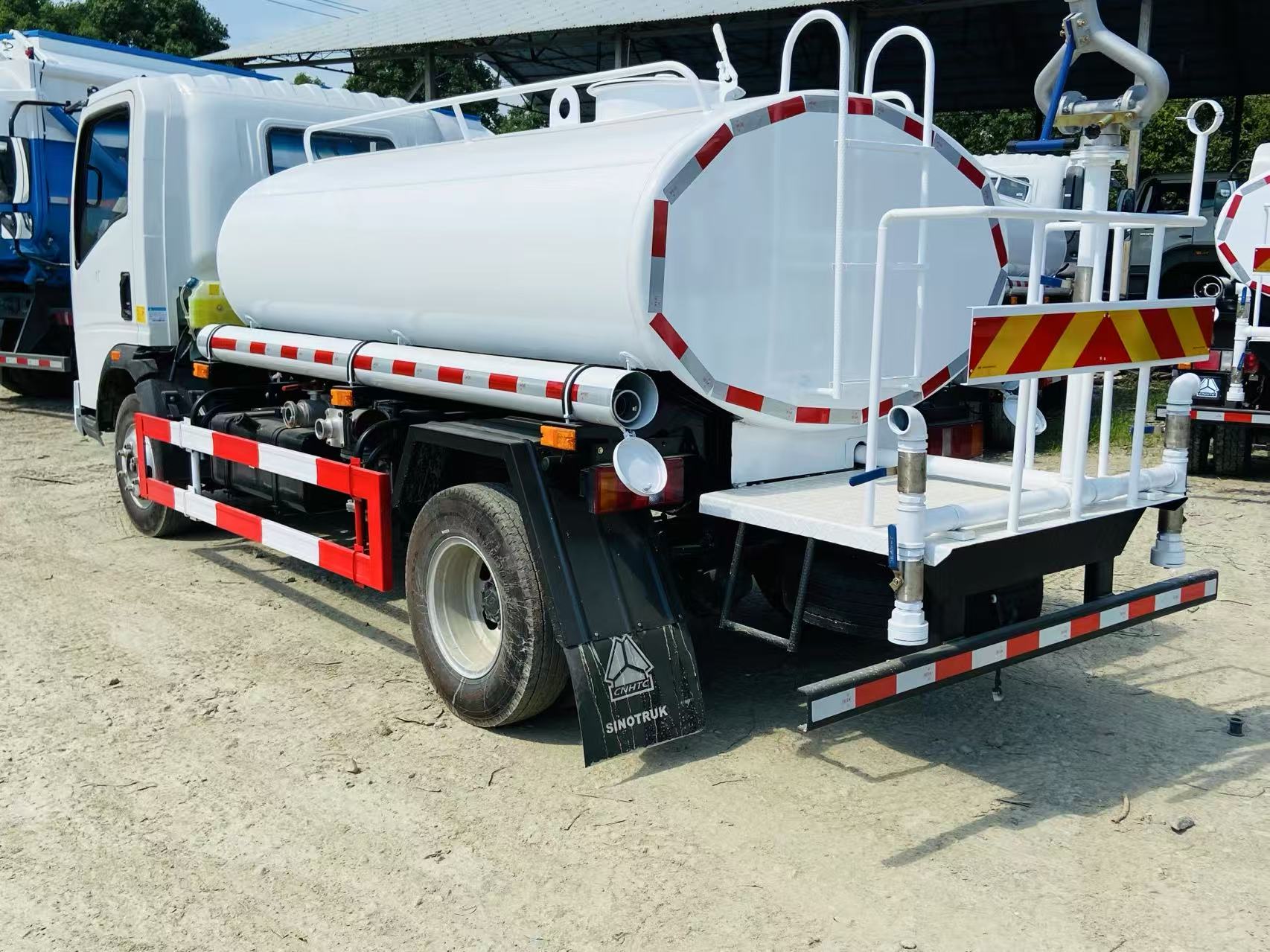
When does a 20,000 liter water truck fit?
A 20000 liter water truck may fit a project that has high, predictable demand, long distances between refill opportunities, and roads designed for the fully loaded vehicle. It can help reduce the number of refill trips when the loading point is reliable and the work is organized in large blocks. It is not automatically the better choice for every large site.
Ask three direct questions: Can the source load 20,000 liters without creating a queue? Can every road, slope, turning point, and work zone accept the loaded water truck? Can the operator discharge the load at the required flow rate without leaving the next task uncovered? If any answer is uncertain, compare a lower tanker capacity with additional refill cycles, or consider how two smaller units would cover different site zones. First clarify the task, then compare configurations, and only then discuss price.
Check the refill cycle and site water supply
Capacity is useful only when the site water supply can keep up. Calculate a complete cycle: travel to source, queue, fill, return, position, discharge, and any cleaning or inspection time. A larger tank that waits at a slow loading point may deliver less water per shift than a smaller water truck that turns quickly.
Before operation, confirm source authorization, water quality for the intended use, fill connection compatibility, drainage controls, and the local rules for road travel and water discharge. By refill cycle, we mean the whole interval from leaving the work zone to being ready to spray or discharge again. This is a verification direction, not a confirmed performance claim for any particular vehicle.
Use a specification checklist before final selection
- State the hourly and shift-level water demand for each job.
- Set the minimum number of viable loads per shift using real travel and filling times.
- Convert proposed volume into water mass, then check gross and axle limits with the final chassis supplier.
- Verify the tanker capacity against access roads, slopes, turning areas, and ground conditions.
- Specify pump, spray, hose, outlet, and control needs for the actual distribution task.
- Confirm the site water supply, water type, loading method, and operator inspection routine.
JINAN CMHAN TRUCK SALES CO., LTD. serves road-construction and municipal-construction audiences according to its current merchant profile. For these applications, a useful inquiry should include the expected daily volume, route conditions, water source location, and the desired discharge task. That information makes it possible to review a water truck configuration for fit rather than treating tanker capacity as a standalone answer.
Conclusion: choose the usable capacity
The most appropriate water truck capacity is the volume that can be legally carried, safely operated, filled reliably, and used before the site needs the next load. Start with demand and cycles, calculate the water mass, then test the proposal against route and equipment constraints. Whether you are considering a compact unit, a mid-range tanker, or a 20,000-liter class vehicle, treat the final specification as a project-specific decision that needs chassis and site verification.