 EN

How to Choose a Trailer Truck for Different Freight Requirements?
Choosing a trailer truck starts with the work, not the body style or the quoted price. A trailer that looks suitable on a specification sheet can still create loading delays, axle-weight problems, or difficult cargo securement once it enters daily service. From a fleet procurement planner’s perspective, the useful question is simple: can this trailer truck carry the intended freight safely and repeatedly on the routes you actually run?
A sound trailer truck selection process connects freight transportation needs to payload, volume, loading method, route conditions, and service support. It also separates what must be confirmed in the final specification from what can be decided early. Use the framework below before comparing offers.
Start with a freight requirement sheet
Before choosing a trailer truck, describe the freight in operating terms. Record the maximum and typical load weight, dimensions, center of gravity, packaging, loading equipment, unloading location, and trip frequency. A single average weight is not enough. The heaviest practical load, its distribution, and the route restrictions usually determine whether a trailer truck is a fit.
- Weight: include cargo, pallets, dunnage, and securement equipment when estimating usable cargo capacity.
- Volume and shape: list the longest, widest, tallest, and most awkward items rather than only cubic volume.
- Handling: note whether freight is loaded by forklift, crane, ramp, conveyor, or manual access.
- Protection: identify exposure to rain, dust, theft risk, temperature variation, or contamination.
- Route: capture pavement quality, gradients, terminal clearances, turning space, and jurisdictional limits.
A useful checkpoint is not just payload rating; relate it to the actual loading and unloading routine. This moves trailer truck selection away from capacity alone and toward usable capacity.
Match the trailer body to the cargo
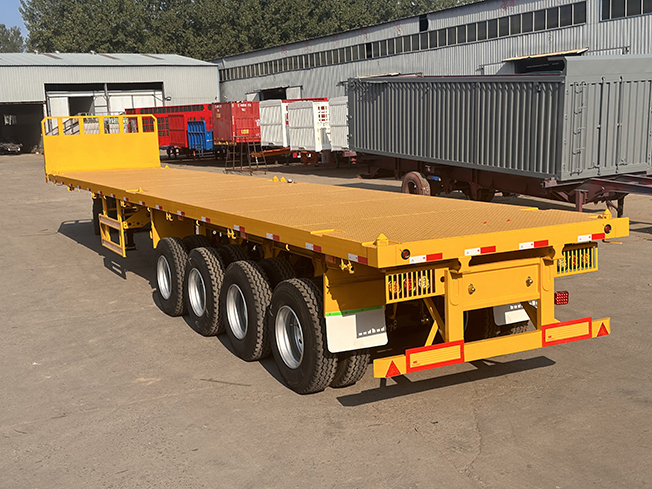
The right trailer truck body depends on how the freight must be contained, accessed, and secured. Dry, palletized shipments often favor enclosed bodies that protect cargo and support dock loading. Long machinery, construction materials, or oversized units may need an open deck and appropriate tie-down access. Bulk materials, liquid cargo, refrigerated goods, and high-value freight each introduce different body, lining, access, or inspection requirements.
For an open-deck trailer truck, ask where tie-down points are located, whether the deck length and height suit the cargo, and how weather exposure will be managed. For an enclosed trailer truck, check door arrangement, internal clearance, floor loading suitability, and forklift access. If multiple cargo families are planned, prioritize the work that drives the tightest constraint rather than assuming one versatile body will suit every load.
In U.S. operations, cargo securement rules state that the aggregate working load limit of a securement system must be at least one-half of the weight of the secured article or group of articles. That is a planning reminder, not a substitute for a route- and cargo-specific compliance review. The trailer truck should therefore be considered together with its anchor points, load-control equipment, and operating procedure.
Calculate cargo capacity beyond the headline number
Headline cargo capacity is only one part of the decision. A trailer truck must keep gross weight and axle loading within the limits that apply to its operating jurisdiction and route. Body weight, axle layout, suspension, wheelbase, fifth-wheel position, and how the load is placed can all affect the payload that can be carried legally and practically.
Ask suppliers to clarify the weight basis used in a proposed configuration. Then compare the empty vehicle combination, expected cargo, equipment, and fuel or ancillary loads against local rules. This is particularly important for dense freight: the volume may fit easily while axle limits become the constraint. It is not simply a cargo capacity issue; more precisely, distribution and loading practice both matter.
| Freight situation | Trailer truck questions to verify | Likely priority |
|---|---|---|
| Dense palletized freight | Axle loading, floor suitability, dock access | Legal payload and load distribution |
| Long or irregular equipment | Deck length, tie-down access, crane loading | Securement and handling clearance |
| Weather-sensitive goods | Body enclosure, door seals, loading exposure | Protection and access method |
| Mixed regional deliveries | Turning radius, door layout, route limits | Operational flexibility |
Check the route and duty cycle
A trailer truck used on smooth highway lanes and scheduled dock work faces a different duty cycle from one used on uneven construction access roads, congested urban routes, or cross-border corridors. Match suspension, axle arrangement, ground clearance, body construction, tire choice, and inspection access to those conditions. If the route and payload are stable, a focused configuration may be practical. If jobs change frequently, define the acceptable operating envelope before paying for flexibility you may not use.
Freight transportation also depends on turnaround time. Review how quickly drivers can open doors, access load space, inspect securement, and complete routine checks. That is the specification side; the next question is how the trailer truck behaves in the daily routine. A configuration that is difficult to load or inspect can reduce utilization even when its rated capacity is adequate.
Evaluate the tractor-trailer connection and fleet fit
A trailer truck is a combination, so confirm compatibility with the tractor units available in the fleet. Check coupling arrangement, fifth-wheel height, electrical and air connections, turning clearance, axle configuration, and the expected distribution of weight between tractor and trailer. The relevant technical question is whether the complete combination suits the intended work, not whether either component appears adequate in isolation.
Also plan for maintenance. Discuss inspection points, brake and tire service access, common wear items, parts availability, and the process for confirming the final configuration. A lower initial price does not by itself answer the operating-cost question. For a logistics vehicle that will make frequent trips, downtime and routine access can matter as much as the purchase figure.
Use a conditional selection checklist
- Define the heaviest, largest, and most difficult freight scenario.
- Set the required cargo capacity after accounting for body weight, equipment, and applicable limits.
- Choose the trailer truck body around protection, access, and securement needs.
- Verify axle loading, route restrictions, and the tractor-trailer combination with local requirements.
- Confirm loading equipment, inspection access, service support, and final specification details before ordering.
The right trailer truck is rarely the one with the largest published number. It is the one whose body, cargo capacity, axle layout, and handling features match the freight requirement and route with clear limits understood. Use that conditional approach to make trailer truck selection more reliable, then ask the supplier to document the final configuration against your operating checklist.