
 EN

How Do Tie-Down Points Improve Flat Bed Semi Trailer Cargo Security?
A flat bed semi trailer makes irregular freight easier to load, but its open deck also makes the cargo-securement plan visible and consequential. Tie-down points improve security because they give chains, straps, and other restraint equipment a defined place to transfer force into the trailer structure. They do not make a load safe by themselves. Their value depends on compatible hardware, correct working-load limits, sound cargo positioning, and checks throughout the trip.
From a fleet procurement planning perspective, the practical question is not simply how many anchor points a trailer has. It is whether their location, condition, and rating support the loads and routes the fleet actually handles. A flatbed trailer carrying bundled steel, machinery, timber, or agricultural equipment may need very different restraint paths even when the deck length is similar.
Why tie-down points matter in cargo securing
When a vehicle brakes, turns, or crosses uneven pavement, cargo tries to continue moving in its original direction. A securement system resists that motion through its connected parts: the cargo attachment, the tie-down, and the trailer anchor. Well-placed tie-down points let the operator create restraint in the directions that matter—forward, rearward, and sideways—without forcing straps across sharp edges or at poor angles.
That is the specification side; the next question is how it behaves in the daily routine. A regularly spaced anchor layout can make it easier to choose a nearer attachment point, maintain a direct load path, and avoid routing a chain around components that were not designed as anchors. For a flat bed semi trailer, this supports repeatable cargo securing across different loads instead of relying on improvised attachment locations.
Four ways anchor-point layout improves load safety
1. It helps create useful restraint angles
A tie-down point that is too far forward, too far back, or too close to the load can produce an inefficient angle. The result may be a restraint that mainly pulls downward when the load also needs forward resistance, or one that pulls sideways without keeping the cargo seated on the deck. Multiple usable anchor locations give the loader more options to align the tie-down with the expected direction of movement.
This is especially important for tall or uneven freight. A useful checkpoint is payload distribution: before deciding on an anchor path, relate the load’s center of gravity and contact area to the loading and unloading routine. Dunnage, blocking, edge protection, and direct restraint may all be needed; tie-down points are only one part of that system.
2. It supports a balanced cargo-securement plan
Evenly distributed tie-down points can help operators secure each section of a long load rather than concentrating all restraint near one end. That can reduce slack-prone spans and make it easier to position securement equipment around bundles, pallets, or machine bases. On a flatbed trailer, the appropriate pattern is not automatically the highest number of straps or chains. It is a pattern that matches the load geometry, the available attachment points, and the rated capacity of every component.
For U.S. operations, FMCSA cargo-securement guidance uses aggregate working load limit as a core concept. In general, the aggregate working load limit of the securement system must be at least one-half of the cargo weight, with the calculation affected by how each tiedown is configured. That is a reason to assess the anchor and the tie-down path together, rather than treating an anchor point as a generic hook location. Local laws and cargo-specific rules may differ, so fleets should verify the requirements that apply to their route.
3. It reduces the temptation to use unsuitable attachment locations
When proper tie down points are accessible along both sides of the deck, a crew is less likely to attach to rub rails, stake pockets, suspension parts, or other features without confirming their intended use and rating. A purpose-designed point also makes pre-trip inspection clearer: the operator can look for deformation, cracks, corrosion, damaged weld areas, or obstruction before connecting a chain or strap.
In practice, condition matters as much as placement. A damaged anchor, worn hook, bent chain link, or cut webbing can undermine an otherwise sensible plan. If an anchor point’s rating or condition is uncertain, it should not be assumed suitable for the load. Use the trailer documentation, equipment markings, and the fleet’s maintenance process to make that decision.
4. It makes inspection and adjustment more systematic
Load safety does not end when the vehicle leaves the yard. Clearly located tie-down points make it easier to identify each connection during a walk-around and notice changes such as slack, shifted edge protectors, or cargo movement. U.S. guidance commonly requires drivers to re-examine cargo securement within the first 50 miles and then at prescribed intervals, including 150 miles or three hours under the applicable rules. That is an operating example, not a substitute for checking the regulations and company policy that govern a particular trip.
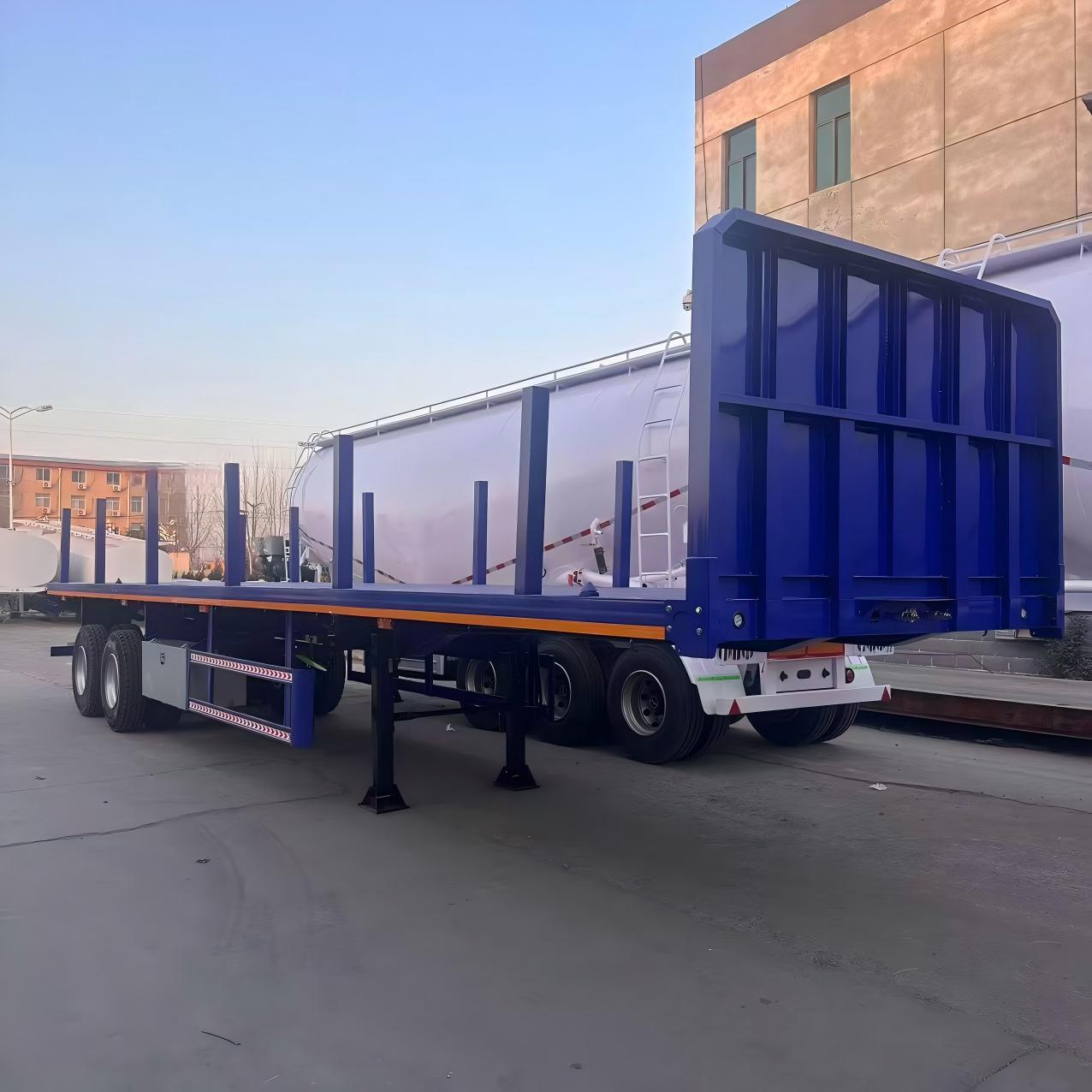
What to evaluate when specifying a flat bed semi trailer
- Anchor spacing: Check whether points are available near the likely cargo positions, not merely at the trailer ends.
- Working-load-limit information: Confirm how the trailer manufacturer identifies anchor ratings and how they relate to the intended tie-down equipment.
- Access: Points should remain reachable after the cargo is loaded, without unsafe climbing or awkward hook angles.
- Deck and side configuration: Consider rub rails, stake pockets, chain slots, and other hardware only for the uses and ratings documented for them.
- Load mix: A fleet that alternates between machinery, pipe, steel, and bagged material may need a more flexible anchor layout than one carrying a stable, standardized load.
- Maintenance access: Include anchor points in inspection routines so damaged hardware is reported and repaired before it is relied on.
A practical loading sequence
- Identify the cargo weight, dimensions, center of gravity, and any manufacturer handling instructions.
- Position the load to support axle distribution and stable deck contact; add dunnage, blocking, or friction measures where appropriate.
- Select rated tie-down equipment and compatible tie down points. Do not infer a rating from appearance alone.
- Plan restraint directions before tightening: consider forward, rearward, lateral, and vertical movement relevant to the load.
- Protect straps and chains from sharp edges, tension the system, and complete a documented walk-around.
- Recheck cargo securing during the journey according to applicable regulation and fleet procedure.
Common mistakes to avoid
One common mistake is equating more anchors with better security. More points only help if they are structurally suitable, correctly rated, and used with a sound restraint plan. Another is selecting a convenient point that produces poor geometry; a short, direct path may not control the movement the load is most likely to make. Finally, crews sometimes inspect the straps and chains but overlook the trailer hardware. Cargo securing is a complete system, so the deck, anchor points, tie-downs, cargo attachments, and protection methods all need attention.
Bottom line
On a flat bed semi trailer, properly located and maintained tie-down points improve cargo security by giving operators safer, more repeatable options for building a restraint system around the actual load. They can support better angles, more balanced restraint, clearer inspections, and fewer improvised connections. If route conditions, payloads, and loading practices are stable, that may be a practical starting point for specifying a flatbed trailer. The final decision should still be based on verified ratings, applicable cargo-securement rules, and the equipment supplier’s documentation.