 EN

How Does a Dump Truck Hydraulic System Work?
A dump truck earns its keep when it can load, travel, and discharge material predictably. The lifting action looks simple from the cab, but the dump truck hydraulic system is a controlled circuit that turns engine power into the force that raises the body. Knowing the sequence helps operators work more safely and gives fleet teams a practical starting point when a body raises slowly, drifts down, or will not lift.
For a buyer or maintenance manager, the useful question is not only “does the body go up?” It is whether the hydraulic lifting system matches the body, payload, duty cycle, and servicing capability of the operation. Layouts vary by chassis and body design, so the truck manual and body-builder instructions take priority over a general explanation.
The main parts of a dump truck hydraulic system
Most truck-mounted systems share the same job: move clean hydraulic oil under pressure to a lifting cylinder, then return that oil to the reservoir in a controlled way. The main components are:
- Power take-off (PTO): A PTO commonly transfers rotational power from the transmission to a hydraulic pump when the operator engages it.
- Hydraulic pump: The pump draws oil from the reservoir and creates flow. Pressure rises when that flow meets the load imposed by the body and material.
- Reservoir, breather, and filtration: The tank stores oil, helps release heat and air, and supplies the pump. Filtration and a clean breather help keep abrasive contamination out of valves and seals.
- Control valve and hoses: The operator’s control sends flow to the lift circuit, holds the body, or routes oil back to tank. Hoses and fittings carry pressure and return flow; their routing must avoid rubbing, heat, and pinch points.
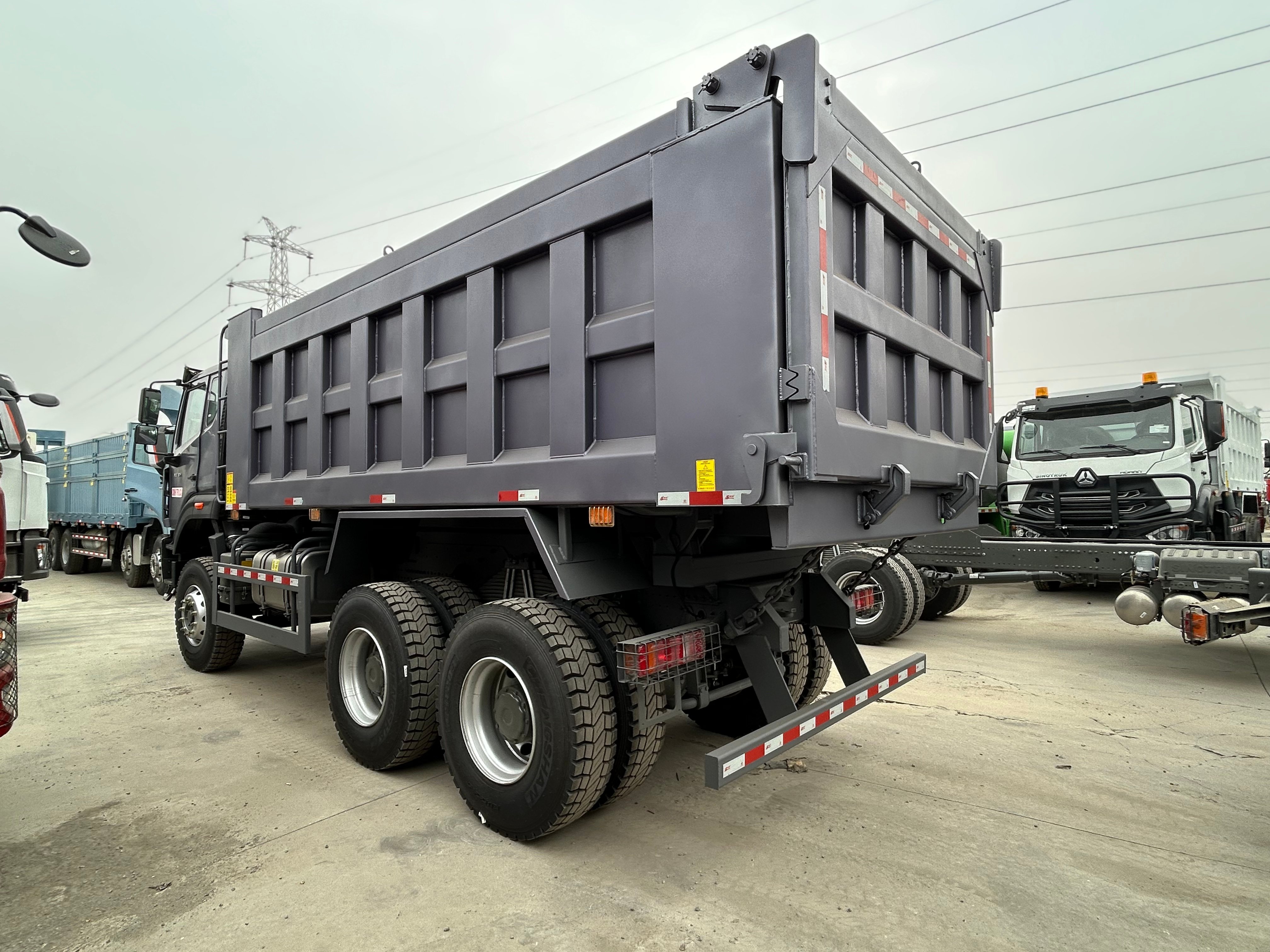
- Hoist cylinder and body pivots: A front-mounted telescopic cylinder or an underbody hoist converts oil pressure into extension force. The cylinder acts through the dump body mechanism, while hinge pins at the rear provide the pivot point.
Many designs use a pressure line to deliver oil and a return path to bring it back. The exact valve arrangement, cylinder stages, and PTO controls differ, which is why replacement parts and service procedures should be matched to the actual truck and body.
What happens during a lifting cycle?
- Prepare the truck. Park on firm, level ground where practical, keep people clear of the rear and sides, and confirm that tailgate and load conditions are suitable for discharge. A raised body changes the truck’s center of gravity, especially on uneven terrain.
- Engage the drive for hydraulics. With the truck in the manufacturer-specified condition, the PTO engages and turns the pump. The pump draws oil from the reservoir.
- Direct oil to the cylinder. Moving the hoist control to “raise” shifts the valve so pressurized oil enters the cylinder. As oil fills the cylinder, the piston extends. On a telescopic unit, stages extend in their designed sequence.
- Lift and tip the body. The cylinder pushes the front of the body upward around the rear pivots. Gravity carries the load toward the tailgate. The operator should watch for material hanging up, unexpected side loading, or a body that is not tracking straight.
- Hold or lower. Returning the control to neutral holds the circuit according to the system design. Selecting “lower” routes oil back toward the reservoir while the body descends under its own weight. The descent should be controlled; do not work beneath a raised body unless the approved body prop or mechanical support is in place.
This is why a hydraulic lifting system is more than a cylinder. Pump flow influences lift speed, the valve controls direction, the cylinder develops force, and the structure must keep the body aligned while it pivots.
Why the dump body mechanism needs stable loading
Hydraulics can raise the body, but they cannot make an unstable load safe. Material frozen to one side, an uneven pile, a partially opened tailgate, soft ground, or a side slope can create lateral forces that the dump body mechanism was not intended to absorb. A body that twists during a lift may damage hinges, subframe members, cylinder mounts, or hoses.
Before tipping, distribute material as evenly as the loading process allows. Choose a firm unloading surface, keep the truck aligned, and raise the body smoothly instead of cycling the control abruptly. If material refuses to slide, lower the body and assess the situation rather than trying to shake a raised body loose. These operating decisions protect the dump truck, people nearby, and the next load schedule.
Common symptoms and likely checks
| Symptom | What to inspect first |
|---|---|
| Body raises slowly or weakly | Correct PTO engagement, reservoir level, visible leaks, suction restrictions, and whether the load or operating conditions exceed the intended duty. |
| Body will not raise | PTO operation, pump drive, control-valve position, fluid supply, and obvious hose or fitting failures. Stop if a leak is suspected; high-pressure fluid can be hazardous. |
| Body creeps down in neutral | Control-valve holding performance, cylinder seals, external leaks, and the service manual’s diagnostic procedure. |
| Jerky lift or noisy pump | Oil level, aeration, suction-side connections, fluid condition, and restrictions. Air in the circuit should be addressed using the manufacturer’s procedure. |
| Oil or wetness around a cylinder rod | Rod condition, seal area, mounting alignment, and the source of the leak. Do not wipe or search for a pressurized pinhole with a hand. |
These are inspection prompts, not a substitute for diagnosis. Pressure testing, internal valve work, and cylinder repair belong with trained technicians using the correct specifications and safety controls.
Truck maintenance that protects hydraulic uptime
Consistent truck maintenance is usually less costly than an unscheduled hoist repair. Build checks around the operating environment and the manufacturer’s service intervals:
- Check hydraulic oil level with the body position specified by the manufacturer, and investigate sudden level changes.
- Inspect hoses, couplings, and clamps for abrasion, swelling, cracks, loose routing, and leaks. Replace damaged components with correctly rated parts.
- Look at cylinder rods for scoring, corrosion, or packed debris before retraction; rod damage can shorten seal life.
- Grease body pivots and hoist pins where required. A binding pivot can make the hydraulic system work harder and make the lift feel abnormal.
- Keep the tank area and breather clean, use the specified fluid, and change filters according to the service schedule. Contaminated oil can accelerate wear in pumps, valves, and seals.
- Record lift complaints and repairs. A pattern such as repeated hose abrasion or recurring aeration often points to a routing, mounting, or operating issue rather than a single failed part.
Questions to ask when specifying a dump truck
When comparing a dump truck for construction, aggregate, municipal, or agricultural work, ask how the body volume, payload rating, hoist geometry, and anticipated material work together. Confirm the PTO and pump arrangement, cylinder style, reservoir access, filter locations, and local availability of compatible service support. The most suitable truck is one whose hydraulic circuit and body design are appropriate for the real route, loading method, and maintenance resources—not simply the highest-rated option on paper.
JINAN CMHAN TRUCK SALES CO.,LTD. supplies trucks, semi-trailers, and construction equipment for customers in Africa, South America, and Southeast Asia. For an export inquiry, share the material being hauled, body configuration, expected operating conditions, and service expectations so the hydraulic layout can be discussed against the intended application.
Key takeaway
A dump truck hydraulic system works by using PTO-driven pump flow to send pressurized oil through a control valve to a lift cylinder. The cylinder raises the body around its rear pivots; controlled return flow lets it come down. Safe unloading, clean oil, sound hoses, maintained pivots, and prompt attention to changes in lift behavior all help the hydraulic system deliver dependable work.