 EN

Flat Bed Semi Trailer vs Low Bed Trailer: Which Is Better for Heavy Equipment?
There is no universal winner between a flat bed semi trailer and a low bed trailer. The sensible choice starts with the machine itself: its travel height, weight, axle or track layout, loading method, route, and the permits likely to be required. A flat deck can be a practical freight solution for machines that fit within height limits and benefit from a flexible, open platform. A low bed trailer becomes more compelling when deck height is the constraint, especially for tall equipment or oversized cargo.
From a fleet procurement perspective, compare the complete job rather than the trailer label. The working question is not “Which trailer is stronger?” It is “Which configuration keeps this equipment transport task manageable, secure, and lawful on the routes we actually use?” Final dimensions, axle ratings, deck construction, and local rules must be confirmed on the specification sheet and with the relevant authorities.
The short answer: start with equipment height and route clearance
A flat bed semi trailer is often the better choice when the machine can be loaded safely on a standard-height deck and still meet route clearance limits. It provides an open, adaptable surface for equipment with a manageable overall height, attachments that can be removed or secured, and jobs that vary from one load to the next.
A low bed trailer, commonly called a lowboy, is usually the better candidate when reducing the loaded height is essential. Its lower main deck can create more clearance for tall excavators, cranes, drilling rigs, or other machinery that would sit too high on a flat deck. That benefit does not remove the need to check permits, bridge restrictions, turning space, and axle distribution; it changes the starting point of the comparison.
Flat bed semi trailer vs low bed trailer at a glance
| Decision factor | Flat bed semi trailer | Low bed trailer |
|---|---|---|
| Deck position | Higher, generally level open deck | Lower main deck between raised sections |
| Typical fit | Equipment that fits height limits and needs a versatile open platform | Tall, clearance-sensitive, or oversized cargo |
| Loading workflow | Often straightforward when ramp angle and machine ground clearance are suitable | May require more planning around detachable gooseneck, ramps, approach angle, and site space |
| Route question | Confirm loaded height and restraint plan | Confirm height savings plus width, length, axle spacing, turning, and permit conditions |
| Freight flexibility | Useful when the same asset handles varied equipment or open-deck loads | Useful when a recurring fleet includes equipment that cannot reasonably travel at standard deck height |
The table is a screening tool, not a specification. A low bed is not automatically the better heavy-haul choice simply because the cargo is heavy, and a flat deck is not automatically suitable simply because the cargo can be chained down. Weight distribution, equipment geometry, and route constraints decide the outcome.
When a flat bed semi trailer is the stronger fit
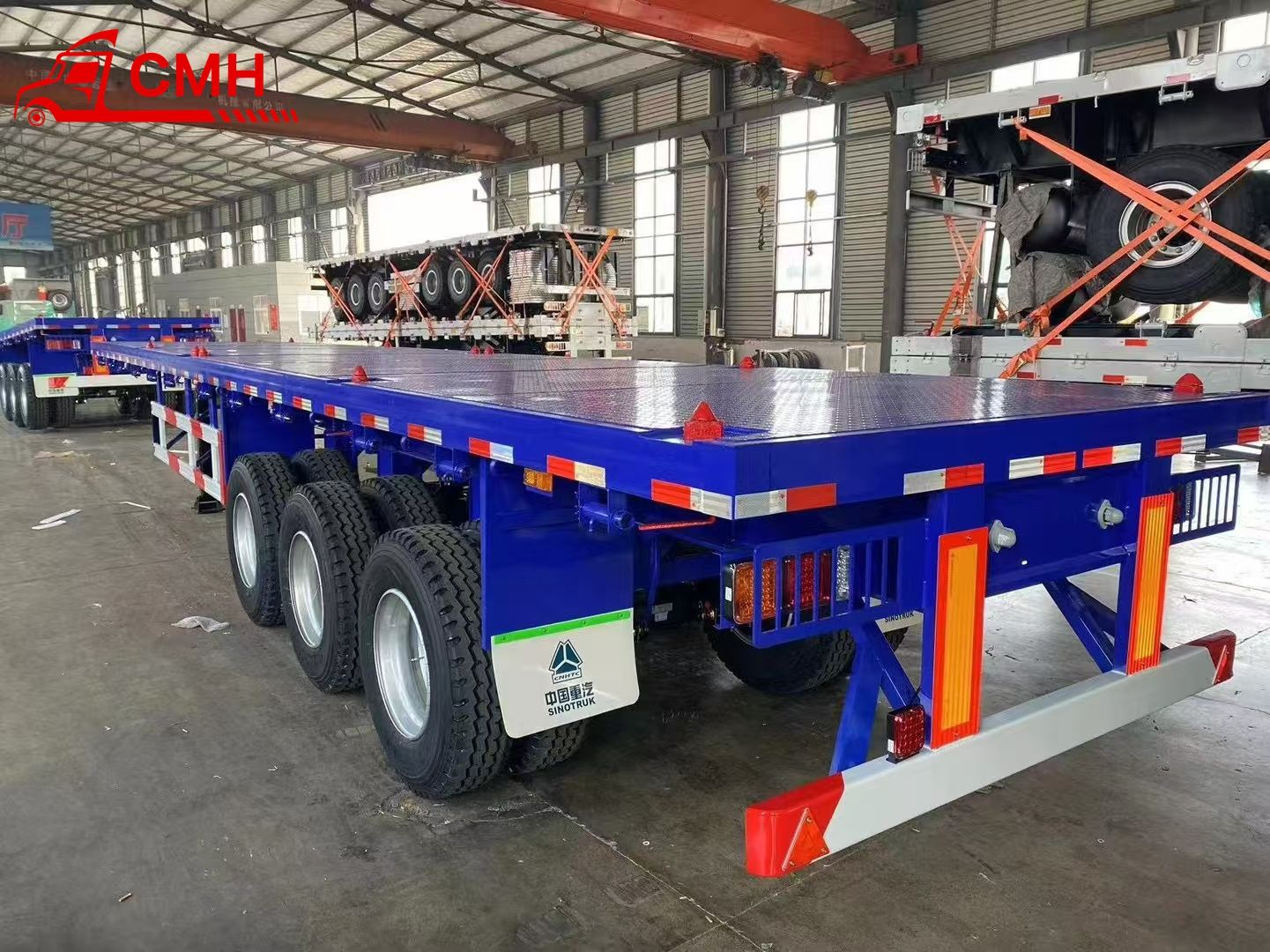
Choose a flat bed semi trailer for equipment transport when deck height is not the limiting issue and operational flexibility matters. Common examples can include machines or attachments that sit within applicable height limits after loading, as well as projects where the trailer may carry different open-deck freight between equipment moves. The open deck also gives the loading team more options for positioning, provided the machine’s center of gravity, tie-down points, and axle distribution have been reviewed.
The trade-off is that a standard deck consumes more vertical clearance. A machine that appears to fit at the yard may become a route problem after accounting for track height, cab height, booms, guards, buckets, or other accessories. In the United States, the Interstate System generally uses an 80,000-pound federal gross vehicle weight limit unless the Bridge Formula produces a lower limit. That is one reason the machine’s weight alone cannot select the trailer: axle-group spacing and route rules matter too. Other countries and individual projects use different rules, so local verification is essential.
A useful checkpoint is cargo restraint. A flat bed can be versatile, but versatility is different from being suitable for every load. Confirm the number and location of tie-down points, the working load limits of the securement equipment, the condition of the deck, and whether attachments can be lowered, removed, or independently secured.
When a low bed trailer earns its extra planning
A low bed trailer is designed to lower the machine’s carried position, which can be decisive for tall equipment. It is often evaluated for excavators, large wheel loaders, pavers, cranes, and other machinery where the loaded height on a flat bed semi trailer would threaten bridge, utility, tunnel, or project-site clearance. The lower deck may also help the team build a more realistic permit plan before the move begins.
However, lower deck height is only one variable. The approach angle must suit the machine; a low-clearance undercarriage can create loading issues if ramps, neck geometry, or ground conditions are wrong. The buyer should also review the usable deck length, wheel wells or axle area, attachment position, turning path, and the space needed at both loading and unloading locations. A low bed trailer can be the safer freight solution for oversized cargo, but only when its configuration matches the actual equipment and route.
In U.S. operations, 49 CFR 393.130 is a useful example of why equipment transport is more than a deck choice. For wheeled or tracked heavy equipment weighing 10,000 lb or more, the rule addresses preparation of accessories and requires restraint against movement in lateral, forward, rearward, and vertical directions using at least four tiedowns. Treat this as an illustration, not global legal advice: confirm current rules in the jurisdiction where the move occurs.
Five checks to make before choosing either trailer
- Measure the transport configuration. Record transport height, width, length, operating weight, attachment position, and ground clearance. Do not rely on a brochure image or a machine’s operating dimensions.
- Map the route before comparing price. Identify bridge and overhead clearances, road geometry, site access, axle restrictions, and permit triggers. A lower deck can solve one clearance problem while leaving other restrictions unchanged.
- Calculate axle and load distribution. Work with the final tractor, trailer, machine position, and any attachments. The goal is a compliant, stable arrangement, not merely a total weight below a headline limit.
- Plan loading and unloading. Check ramps or detachable-gooseneck workflow, slope, surface condition, machine ground clearance, spotter procedures, and whether the site has enough room for safe alignment.
- Verify securement as a system. Review rated anchor points, tiedowns, blocking or chocking where applicable, accessory restraint, inspection intervals, and the qualified person responsible for the final plan.
A practical decision rule for heavy equipment buyers
Start with a flat bed semi trailer when the equipment can stay within height and route limits on a standard deck, its loading angle is workable, and the business needs broad open-deck flexibility. Start with a low bed trailer when reducing loaded height is the central requirement and the equipment, route, and loading sites support the more specialized workflow.
For mixed fleets, the decision may not be either/or. A general flat bed semi trailer can cover routine equipment transport and adaptable freight, while a low bed trailer is reserved for recurring tall or permit-sensitive moves. What matters is that the final configuration is confirmed against the actual machine, the truck-and-trailer combination, and the planned route.
Conclusion: match the trailer to the task, not the name
The better trailer for heavy equipment is the one that creates a safe, compliant, and workable transport plan. A flat bed semi trailer brings flexibility when height is manageable. A low bed trailer brings valuable clearance when the machine would otherwise be too tall. Before ordering or dispatching either one, collect the equipment dimensions, weight distribution, loading method, route restrictions, and securement requirements. Then have the final configuration reviewed against local regulations and the manufacturer’s current specifications.