 EN

Why Are Flat Bed Semi Trailers Preferred for Oversized Industrial Cargo?
When a load has an awkward footprint, lifting points above the deck, or dimensions that do not fit behind a trailer wall, a flat bed semi trailer is often the first configuration considered. The preference is not simply about having an open deck. For oversized freight, the open platform gives planners more ways to approach the load, position it around its center of gravity, and build a securement plan that fits the cargo rather than forcing the cargo into an enclosed body.
From a fleet-procurement perspective, the useful question is not whether a flat bed semi trailer is “better” in every situation. It is whether the cargo geometry, loading method, route, and unloading routine support an open-deck trailer. That distinction matters in industrial logistics, where a single shipment may involve fabricated steel, machinery skids, pipe, transformers, or equipment that needs crane access.
Open deck access makes irregular cargo easier to handle
The defining advantage of a flat bed semi trailer is access from the top, both sides, and rear. A crane can lower a long beam or a crated machine directly onto the deck. A forklift can approach from the side when the load and site layout allow it. Riggers also have room to place blocking, protect edges, and adjust the cargo before the vehicle leaves the yard.
That freedom is particularly useful for cargo hauling jobs in which the shipment is wider than a normal loading-door opening, taller than an enclosed body can accept, or too irregular for a fixed internal layout. It can also reduce handling steps. Instead of transferring an oversized item through a constrained opening, the team can plan one controlled lift onto the flat bed semi trailer.
Open access does not mean no planning. The loading crew still needs verified lift points, a known center of gravity, compatible lifting equipment, and a clear handoff between the shipper, carrier, and consignee. If those details are uncertain, the open deck makes the issue more visible; it does not remove the issue.
It supports a more flexible load envelope
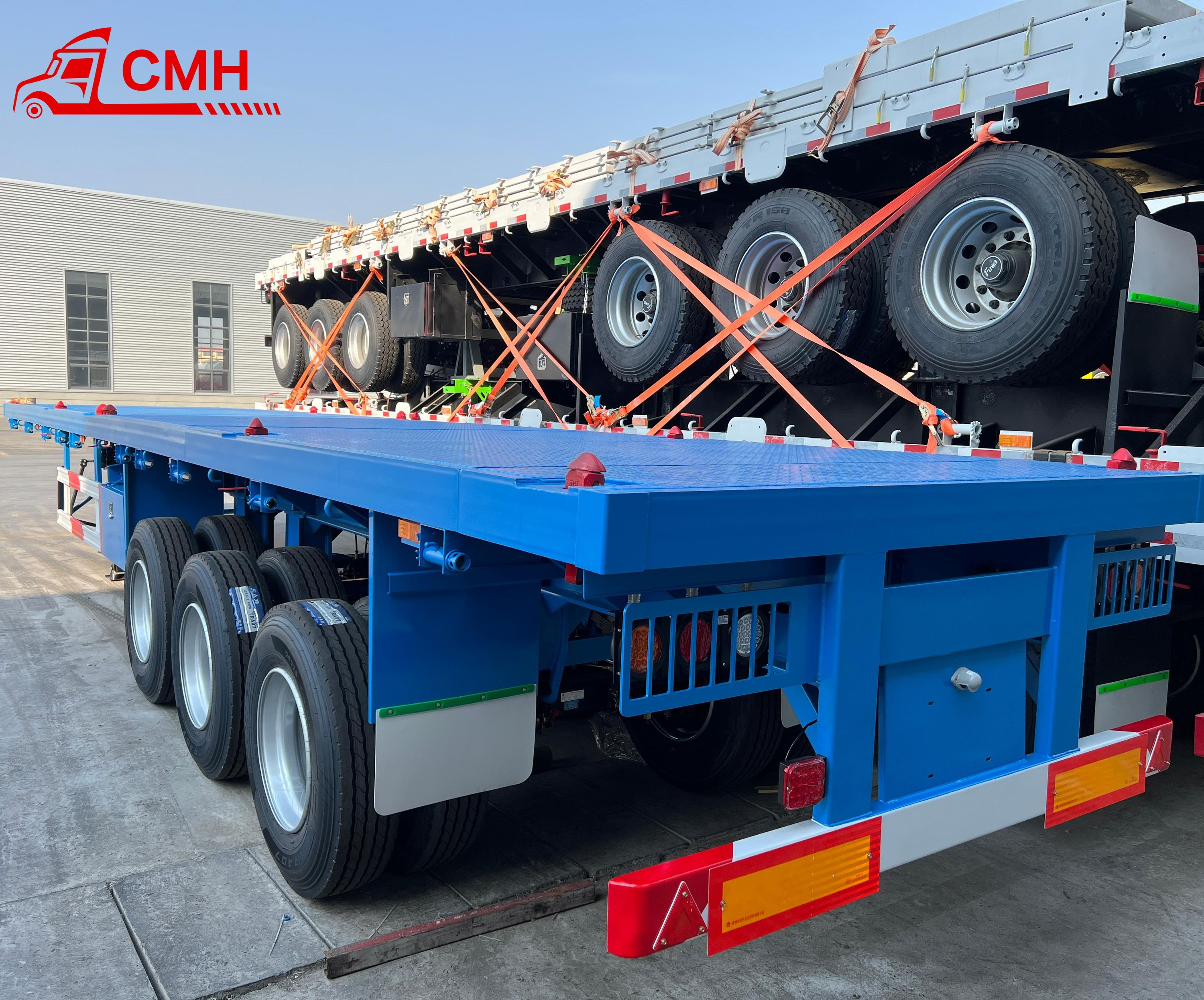
A flat bed semi trailer is commonly selected because the deck does not impose sidewall or roof limits on the load shape. Long structural sections, bundled pipe, industrial frames, and machinery can be assessed against deck length, axle loading, height, width, and permitted overhang rather than against an enclosed box. That creates practical options for oversized freight, especially when the load must be positioned to keep its mass where the trailer and tractor combination can manage it.
Flexibility should not be confused with unlimited capacity. A flat bed semi trailer still has configuration-specific limits for deck strength, axle group loading, kingpin loading, tire ratings, and legal or permitted dimensions. A cargo item may fit physically and still require a different configuration because its center of gravity is too high, its axle distribution is unfavorable, or its height leaves insufficient clearance on the route.
For that reason, experienced industrial logistics teams start with a load sheet. Record overall length, width, height, weight, center of gravity, lifting points, support locations, and any loose or projecting components. Those inputs help determine whether a conventional flat bed semi trailer, a step deck, an extendable unit, or a specialized multi-axle solution is appropriate.
Securement can be planned around the cargo
Securement is another reason a flat bed semi trailer is useful for industrial loads. An accessible deck allows the team to identify practical anchor locations, arrange chains or webbing around the load, and use blocking or dunnage where the cargo needs support. The right plan depends on the commodity, the trailer’s rated anchor points, the working load limit of the devices, and the applicable transport rules.
In the United States, cargo-securement rules provide a useful illustration of why length and restraint strategy must be considered together. For an article longer than 10 feet that is not blocked against forward movement, the rules describe two tiedowns for the first 10 feet and an additional tiedown for each further 10 feet or fraction. That is not a universal prescription for every market or commodity, but it shows why “it fits on the deck” is not enough for a flat bed semi trailer decision.
A useful checkpoint is payload distribution: before selecting a flat bed semi trailer, relate tie-down angles, contact points, and dunnage placement to the actual loading and unloading routine. A securement drawing or pre-trip review can expose issues such as sharp edges, unsupported machine bases, or a load that cannot be checked easily after departure.
Route planning is more transparent for oversized work
Open-deck cargo often makes its transport profile easier to measure and communicate. With a flat bed semi trailer, planners can calculate the loaded height, width, length, and axle distribution from the cargo and deck arrangement, then compare those values with route and permit requirements. This is essential when a shipment needs escorts, a route survey, or time restrictions.
Permit triggers are local, not universal. For example, Minnesota’s oversize program requires route surveys at certain very large dimensions, while other authorities use different thresholds and procedures. The operational lesson is consistent: measure the loaded combination early, verify jurisdiction-specific requirements, and do not assume that an industrial load can use the same route as general freight.
This is where a flat bed semi trailer can be a trailer solution rather than merely a platform. Its predictable deck geometry lets the transport team test alternative positions for a tall or long item before permits, escorts, and delivery appointments are finalized.
Why flexibility can improve project coordination
Industrial cargo rarely moves in isolation. A shipment may need a crane slot, a restricted site gate, protective wrapping, tarping, a permit window, and a receiving crew. A flat bed semi trailer gives those parties a visible, accessible work area. That can simplify inspection before release and help the consignee plan the unloading sequence.
The benefit remains conditional. Cargo exposed on a flat bed semi trailer may need weather protection, corrosion control, or containment for loose components. High-value equipment may need additional security planning. If the cargo needs a lower loaded height, a step deck or lowboy may be preferable; if it needs a protected environment, an enclosed trailer may be the safer choice.
A practical selection checklist
- Define the cargo: Confirm dimensions, weight, center of gravity, support points, lifting points, and sensitive surfaces.
- Match the configuration: Evaluate the deck length, deck height, axle layout, anchor points, and rated capacities of the proposed flat bed semi trailer.
- Design securement: Specify dunnage, chains, straps, edge protection, and inspection access under the rules that apply to the shipment.
- Check the route: Verify permits, bridge and overhead clearances, turning space, escort needs, and site access.
- Plan the handoffs: Align shipper, carrier, rigging crew, and consignee on loading, en-route checks, and unloading responsibilities.
The bottom line
A flat bed semi trailer is preferred for many oversized industrial cargo moves because its open deck supports flexible loading, adaptable positioning, accessible securement, and clearer route planning. Those advantages are most valuable when they are tied to verified cargo data and a configuration review—not treated as a blanket answer. If the route and payload are stable, a flat bed semi trailer may be the practical starting point; if deck height, weight distribution, or protection needs are more demanding, the next step is to compare specialized trailer options before booking the move.