 EN

What Equipment Can a Water Truck Carry for Dust Control?
A water truck does more than haul a tank of water to a jobsite. For dust control, it is a mobile application platform: the tank stores the supply, while a pump, piping, valves, spray hardware, and operator controls determine where that water goes and how evenly it is placed. A useful selection process starts with the site’s traffic, road width, surface condition, refill access, and shift length, not with tank capacity alone.
From a fleet procurement perspective, the relevant question is whether the water truck equipment matches the duty cycle. A broad haul road, a tight demolition area, and a stockpile perimeter can all need water, yet they can call for very different spray patterns and operator access. The following guide explains the equipment commonly carried on a dust control truck and the questions to ask before specifying it.
The equipment package starts with the tank and chassis
The tank gives a water truck its working supply, but it is only one part of the system. Tank volume, baffling, fill arrangement, overflow protection, level indication, and cleanout access affect how the truck can be filled, moved, inspected, and emptied. A water tanker also needs a chassis whose payload rating, axle arrangement, traction, and braking capability suit the anticipated road and site conditions.
Do not treat a larger tank as an automatic upgrade. More carried water can reduce refill trips, but it changes vehicle weight and may affect access on soft ground, grades, or constrained sites. A practical water truck specification therefore compares usable volume with route length, legal weight limits, refill time, and the amount of water actually applied per pass. The exact capacity and tank material should be confirmed against the project requirement and applicable local rules.
Pump and power system: what moves the water
A dust control truck normally needs a pump to move water from the tank to each outlet. Common arrangements may be driven by the vehicle’s power take-off, an auxiliary engine, or another approved power source. What matters operationally is whether the pump can deliver the required flow and pressure to the selected outlets without making routine operation unnecessarily complicated.
Ask the supplier to clarify the pump curve, prime requirements, intake protection, service access, and the controls available at the cab or rear work area. For a water truck used on variable terrain, the pump layout also needs sensible protection from debris and vibration. Strainers or filters can help protect downstream equipment, but they must be accessible for inspection and cleaning. That is the specification side; the next question is how the flow is divided across the spray system.
Spray system components for broad-area dust control
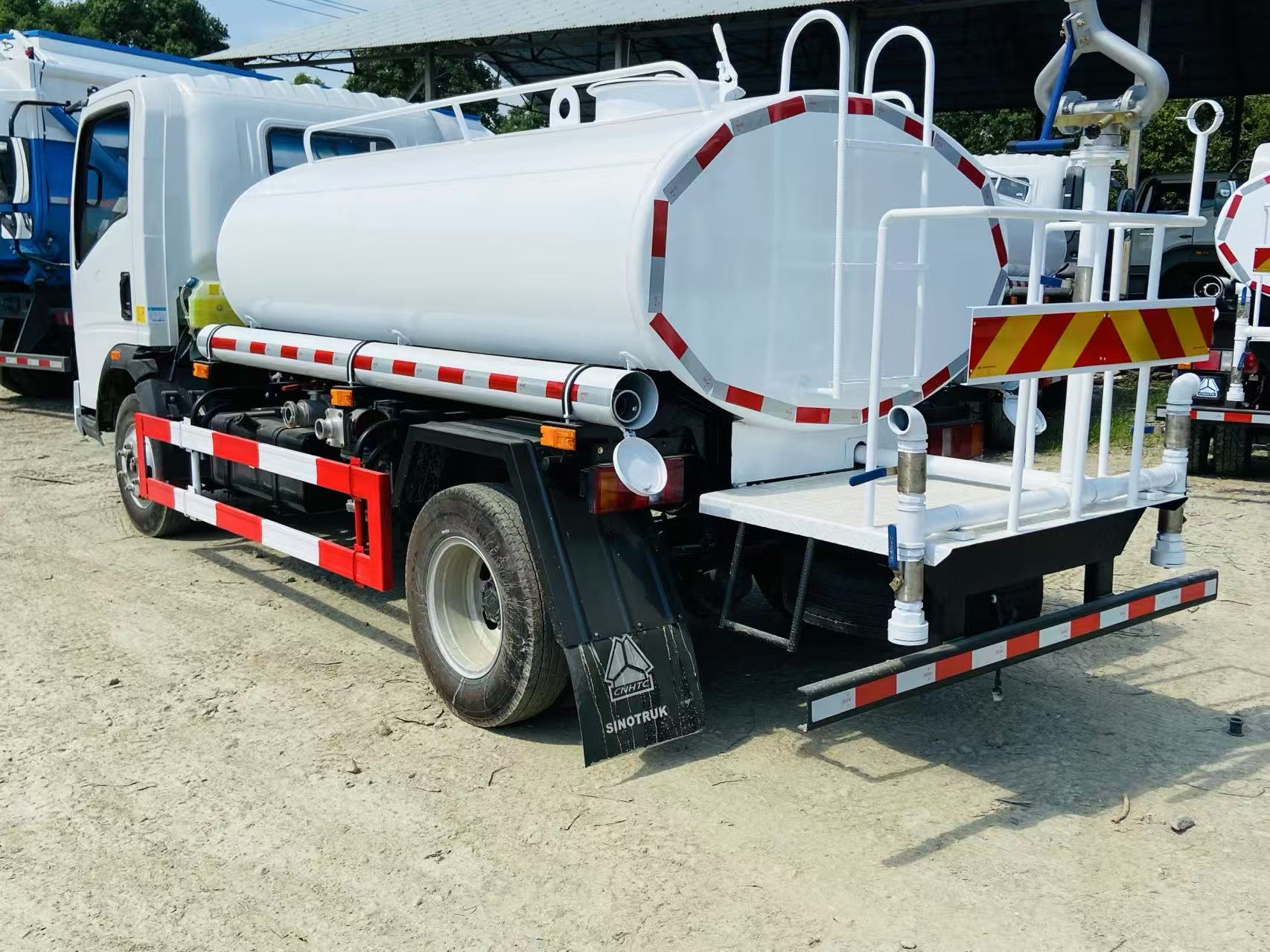
The typical spray system on a water truck includes distribution piping, valves, spray bars, and nozzles. A spray bar is the mounted pipe that carries several spray heads across a working width. The nozzles turn pressurized water into a defined pattern. Together, they help the operator place water across a road, pad, or work zone rather than dumping it in one spot.
- Rear spray bar: Often used for a consistent pass along haul roads, staging areas, or other open surfaces.
- Side spray or side bar: Helps reach shoulders, windrows, or the edge of a travel lane when a centered rear pattern is not enough.
- Adjustable nozzles: Let the crew match the pattern to the width, surface, and wind conditions within the limits of the selected system.
- Individual valves or zones: Allow a spray system to isolate an outlet or reduce unnecessary application on a narrow section.
- Pressure gauges and flow-related controls: Give the operator feedback so a water tanker can be run consistently rather than by guesswork.
Uniformity matters because too little water may leave dust active, while too much can create runoff, soft spots, or traffic problems. Water application is recognized in fugitive-dust control guidance, but the required method, schedule, and recordkeeping depend on the site and jurisdiction. A water truck should be specified to support the project plan, not treated as a universal compliance solution.
Hose reel, hand line, and washdown equipment
A fixed spray bar is efficient for repeated passes, but it cannot reach every location. Many water truck equipment packages can include a hose reel, hand line, hose, and spray gun or nozzle for targeted work. This equipment can be useful around curb lines, equipment parking areas, stockpile edges, conveyor transfer zones, or places where a truck cannot safely position a bar.
The important detail is workable reach and safe handling. Consider hose length, reel location, coupling type, storage, operator footing, and whether the team needs to control the flow from the point of application. If the work regularly shifts from road passes to spot treatment, a dust control truck with both broad-area and hand-operated outlets may be more useful than a truck configured for only one task.
Water cannon or monitor for targeted distance work
A water cannon, sometimes called a monitor, is a directional outlet that can project water toward a defined area. On a water truck, it may help with stockpiles, active loading zones, or other locations where a broad rear pattern is not the right tool. It should not be selected simply because it reaches farther. The team needs to evaluate the desired pattern, wind exposure, visibility, safety boundary, mounting location, and control method.
For example, a cannon can be useful when the application point is offset from the truck path. If the route and payload are stable, that may be a practical starting point. But where overspray could affect workers, traffic, material handling, or adjacent property, controllability is just as important as reach. Confirm the final water truck layout with the responsible site team and equipment provider.
Control valves, cab controls, and automation options
Operator controls make the spray system usable during real work. A water truck may use manual valves, in-cab switches, pneumatic controls, electric controls, or a combination of these. The better choice depends on who operates the system, how frequently the pattern changes, and whether the operator can make adjustments without creating a safety issue.
For recurring haul-road work, zoned controls can allow the operator to turn on only the outlets needed for a given width. For irregular work, simple and clearly labeled manual controls may be easier to inspect and troubleshoot. Optional rate-control or GPS-linked systems can be considered where a site has a defined dust-management program, but their value should be judged against the operating process and support capability—not assumed from a feature list.
Safety, service, and winterization equipment
Dust control is not only about spray coverage. A workable water truck also needs practical safety and service provisions. Depending on the site and configuration, review access steps, handholds, lighting, conspicuity equipment, guards around moving parts, drain points, isolation valves, and a clear inspection routine. The relevant technical question is whether each item suits the route, climate, and daily operating routine.
Cold-weather work introduces another decision: lines, pumps, valves, and fittings may require a documented draining or protection procedure when freezing conditions are possible. Where the water source contains sediment, an appropriate filtration and cleaning routine can protect nozzles and valves. These are not generic add-ons; they affect whether the water truck can be returned to service reliably after each shift.
A practical equipment checklist before you order
- Map the surfaces to be treated: haul roads, pads, stockpiles, shoulders, or localized work zones.
- Estimate the working width and decide where rear, side, hand-line, or cannon coverage is needed.
- Match tank volume and chassis capability to refill access, route length, ground condition, and payload limits.
- Request pump, nozzle, valve, hose-reel, and control details in the configuration record.
- Review service access, drainage, safety equipment, and site-specific regulatory obligations before final approval.
A suitable water truck for dust control is not defined by one accessory. It is a coordinated system in which the tank, pump, spray system, targeted outlets, controls, and maintenance provisions fit the actual job. When comparing a water tanker, ask for the equipment layout and operating limits in writing, then relate them to the planned application routine. That approach produces a more useful dust control truck specification than choosing capacity or a single spray feature in isolation.