 EN

Why Are 8x4 Dump Trucks Preferred Over 6x4 Models for High Payload Applications?
For a contractor or fleet buyer planning repeated bulk-material runs, choosing a dump truck is less about picking the largest body and more about matching axle layout to the real load, route, and duty cycle. An 8x4 dump truck is often preferred when payloads are consistently high because its four axles provide another load-bearing position. That can make it easier to distribute gross weight across the truck, support a larger body specification where permitted, and keep the vehicle within the limits that apply to its operating market. It is not an automatic upgrade for every job, however. A 6x4 dump truck can be the more productive choice where access is tight, loads are moderate, or maneuverability matters more than maximum carried volume.
The basic difference: an extra axle changes the payload conversation
The notation describes driven wheels and total wheel positions. In everyday fleet language, a 6x4 dump truck normally has three axles, while an 8x4 dump truck has four. The key practical difference is not simply that one truck is longer. The fourth axle gives designers another point through which the loaded vehicle can carry and distribute weight.
That matters with dense bulk materials such as aggregates, sand, excavated soil, and crushed stone. A body can look large enough for the job but still create an axle-loading problem if the material sits too far forward, too far rearward, or above the approved gross vehicle mass. The extra axle on an 8x4 dump truck gives more room to balance the chassis, suspension, body, and payload as a system. For heavy hauling, this can be more valuable than a headline body-volume figure.
Actual permitted payload capacity is not defined by axle count alone. It depends on the certified chassis, axle ratings, tyre specification, body tare weight, suspension, route rules, and local axle-load regulations. Buyers should therefore treat any generic payload number as a starting point for discussion, not a procurement specification.
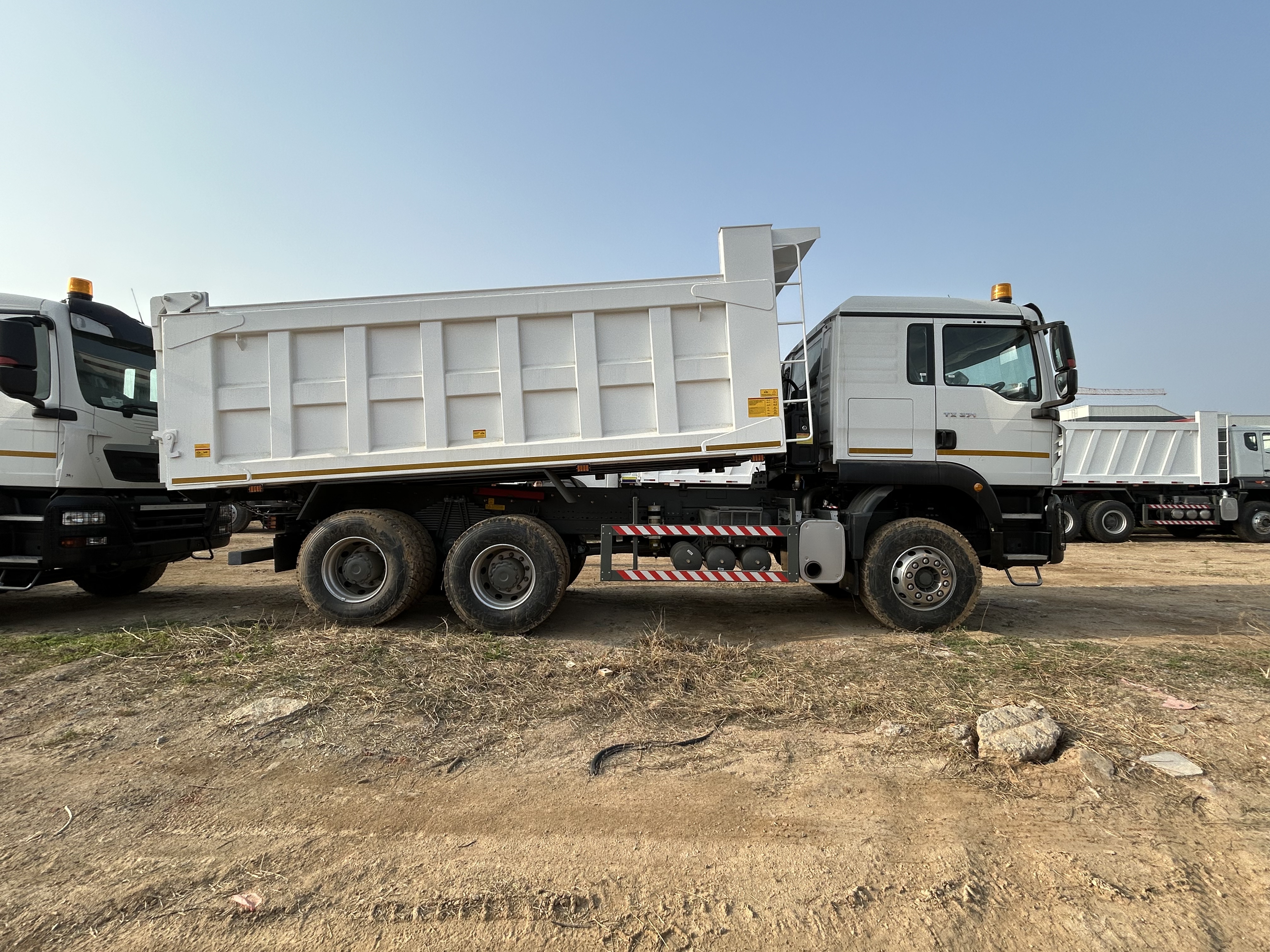
Why an 8x4 dump truck suits high-payload work
1. Better weight distribution for heavy hauling
When the work repeatedly involves high-density material, an 8x4 dump truck can distribute the loaded weight over four axles rather than three. This helps a fleet plan around legal axle-load limits and reduces the pressure to make a three-axle layout do work it was not configured to handle. The benefit is especially relevant when the truck operates at a consistent, high payload capacity instead of occasionally carrying a peak load.
Good distribution still depends on body geometry and loading practice. The buyer should confirm the body overhang, centre of gravity, target material density, and expected loading pattern. An additional axle cannot correct poor loading discipline or a body that is mismatched to the chassis.
2. A more stable platform for a high-volume body specification
High-payload projects frequently need a body designed around both volume and material density. The 8x4 layout usually offers more scope for a longer wheelbase and a body arrangement that fits the intended work, subject to the truck maker’s approved specification. For repeated quarry-to-site, road-construction, and major earthmoving cycles, that can improve the match between the truck and the material flow.
Stability should be assessed as an operating condition, not promised as an inherent feature. Road camber, ground firmness, loading height, tyre condition, suspension configuration, and tipping procedure all affect how a dump truck behaves. A configuration review should cover those factors before a fleet standardizes on a body size.
3. Fewer compromises when payload is the priority
A 6x4 dump truck is frequently a versatile all-rounder. But if each trip is near the upper end of the project’s payload requirement, the fleet may face recurring trade-offs among body size, legal axle load, and route suitability. An 8x4 dump truck is often chosen because it gives procurement teams more configuration headroom to balance those constraints. The aim is not simply to load more; it is to carry the planned material within the approved limits of the vehicle and destination market.
Where a 6x4 dump truck can still be the better decision
The extra axle brings trade-offs. A 6x4 dump truck may be shorter, lighter in some comparable specifications, and easier to turn on constrained sites. For urban work, narrow haul roads, smaller stockpiles, or mixed duties where a truck spends substantial time empty, the 6x4 layout can offer a better operational fit. It may also simplify certain maintenance routines because there is one fewer axle assembly to inspect and service.
That is why the question should not be “which layout is better?” It should be “which layout moves the required material on the actual route without creating avoidable cost or compliance pressure?” If a project rarely reaches high payload capacity, a properly specified 6x4 dump truck can be the more efficient asset. If high loads are routine and the route accommodates the longer chassis, 8x4 may be the more defensible choice.
A practical comparison for fleet buyers
| Decision factor | 8x4 dump truck | 6x4 dump truck |
|---|---|---|
| Axle arrangement | Four axles provide an additional load-bearing position. | Three axles suit many general hauling applications. |
| High payload capacity planning | Often preferred for repeated heavy hauling where approved weight must be spread across more axles. | May suit moderate or variable loads within its certified limits. |
| Site access and turning | Requires review of wheelbase, turning space, and site layout. | Often easier to position on tighter sites. |
| Body selection | Can support a high-volume configuration when manufacturer approval and local rules allow. | Should be matched carefully to material density and axle limits. |
| Key procurement question | Can the route and approved specification support consistently high loads? | Will versatility and maneuverability produce more value than maximum capacity? |
Questions to answer before specifying the truck
- What material will be carried? Obtain expected density, moisture variation, and load volume. Wet soil, rock, and aggregates can change the practical payload calculation substantially.
- What is the legal and route-specific limit? Confirm applicable gross and axle-load limits for every operating jurisdiction, including bridges, mine or quarry roads, and site restrictions.
- How is the body approved? Request a chassis-and-body weight distribution calculation for the proposed body, hydraulic system, tyres, and accessories.
- What does the route demand? Review grades, turning areas, haul-road width, surfacing, loading equipment, and unloading conditions. Heavy hauling is a route problem as well as a truck problem.
- What will be checked at handover? Confirm axle ratings, body dimensions, tare weight, payload documentation, maintenance access, and the final configuration against the purchase order.
How to make the final 8x4 versus 6x4 choice
Choose an 8x4 dump truck when the operation has repeatable high-load cycles, suitable access, and a verified chassis/body combination that can distribute the intended load within applicable limits. It is particularly relevant for bulk-material fleets where payload capacity and predictable material flow drive the economics of each trip.
Choose a 6x4 dump truck when the task needs a more compact all-rounder, when loads do not consistently justify a fourth axle, or when site maneuverability is the operational constraint. In either case, do not approve the truck from axle notation alone. Ask the supplier for the final specification sheet, weight-distribution calculation, and configuration confirmation record for the market where the truck will work.
For B2B procurement, the strongest decision is the one supported by material data, route data, and a verified final build. JINAN CMHAN TRUCK SALES CO.,LTD. supports truck and construction-equipment procurement discussions for logistics, road-construction, municipal, industrial, and agricultural transport applications. A detailed duty-cycle brief helps the team assess which dump truck configuration should be reviewed for the project.