 EN

Maintenance Trucks Can Be Equipped for Mechanical, Electrical, and Hydraulic Repairs.
A well-planned maintenance truck is more than a pickup with cabinets. It is a field workspace that helps a technician diagnose faults, carry the right tools, and complete controlled repairs without sending every asset back to a depot. For logistics fleets, road-construction teams, municipal contractors, and equipment operators, the value is not simply mobility. It is the ability to bring a repeatable repair process to the point where downtime occurs.
A suitable configuration starts with the jobs the truck must support. A crew that handles routine mechanical service needs different storage, lifting, and consumable capacity than a team that performs electrical maintenance or hydraulic repair. Treating all three as one undefined service package usually produces an overloaded body, incomplete tools, and unclear safety boundaries.
Start with the repair scope, not the body layout
Before selecting drawers, cranes, compressors, or power systems, list the work orders the maintenance truck is expected to close in the field. Separate planned inspections from corrective work, and distinguish quick interventions from repairs that should return to a workshop. This keeps the vehicle useful without turning it into an unsafe substitute for a fixed facility.
- Mechanical service: inspections, hose and belt replacement, fastener work, lubrication, filtration, wheel-end checks, and controlled component changes.
- Electrical maintenance: battery and charging checks, lighting circuits, connectors, wiring harness diagnosis, and protected test-equipment use.
- Hydraulic repair: leak inspection, hose replacement, fitting work, fluid handling, pressure-related troubleshooting, and cleanliness control.
A mobile repair truck can support all three categories when the equipment list is based on actual duty cycles, vehicle types, and technician competency. The configuration still needs a clear escalation rule: high-voltage systems, major lifting work, structural repair, and tasks requiring specialized test facilities should be referred to qualified personnel or a suitable workshop.
Build separate work zones inside one maintenance truck
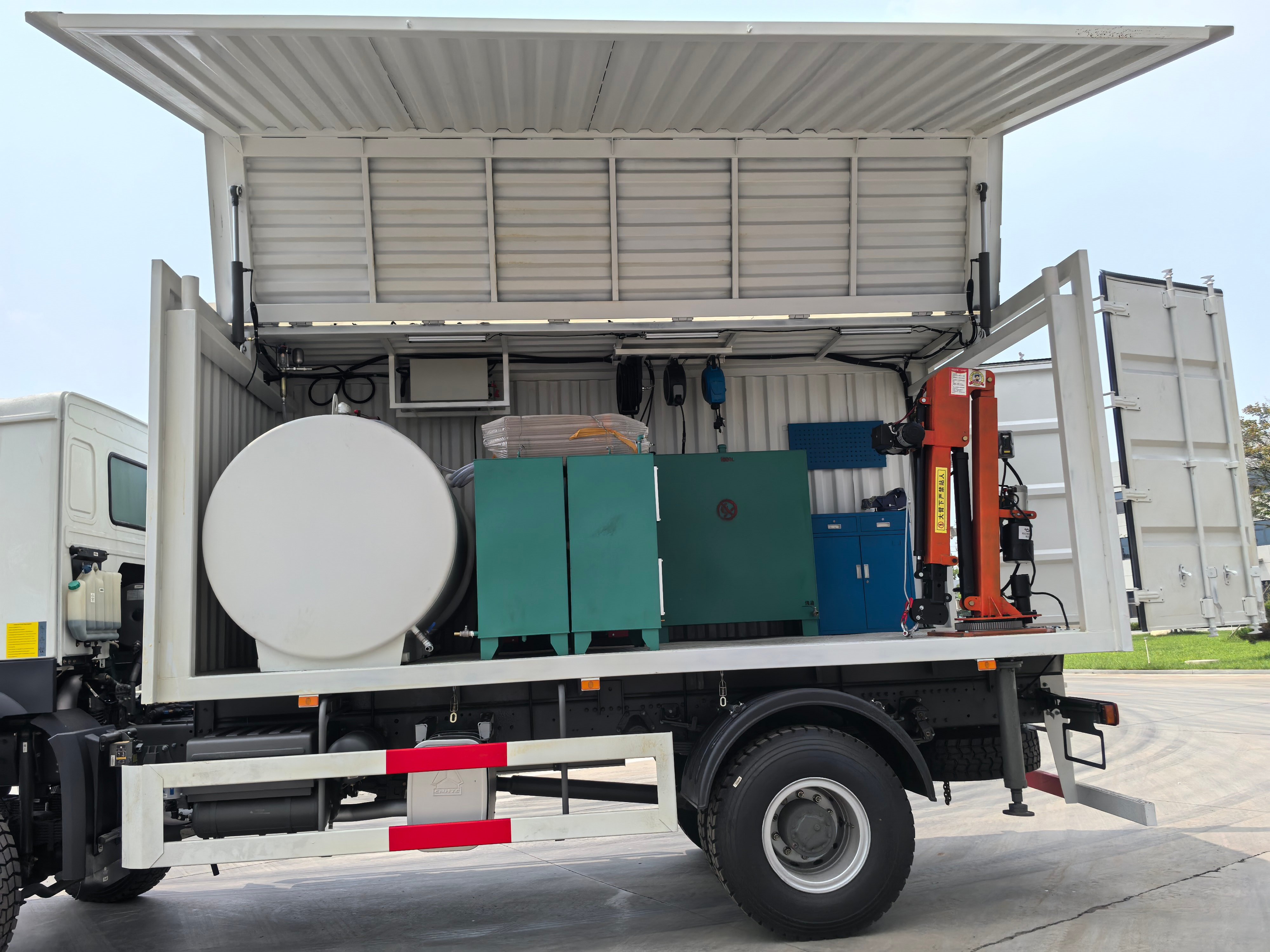
Mixed-trade capability is easier to manage when the body is organized as zones rather than as a single collection of tools. Use secure, labelled compartments so that parts, fluids, electrical instruments, and dirty recovery items do not compete for the same space. Weight distribution, axle ratings, access doors, and load restraint all need review against the final chassis specification.
Mechanical service zone
Reserve robust low-level storage for hand tools, torque tools, jacks or approved lifting accessories, filters, and common wear parts. Frequently used items should be reachable from ground level. If a crane or lifting device is considered, confirm the rated capacity, mounting method, operating envelope, and the site conditions in which it may be used. A mechanical service zone is most effective when it supports inspection and replacement work without encouraging improvised lifting.
Electrical maintenance zone
Electrical tools need a clean, dry, lockable area. Store meters, leads, terminals, heat-shrink materials, protective equipment, and documentation away from hydraulic fluid and abrasive tools. Provide protected charging or auxiliary power only after confirming electrical load, fuse protection, grounding requirements, and the truck’s final electrical design. Label circuit isolation points and keep current wiring references available for the assets the team supports.
Hydraulic repair zone
A hydraulic repair area benefits from dedicated hose protection, capped fittings, absorbent materials, clean containers, and a method for segregating used fluid. Contamination control matters: a replacement hose or fitting is of limited value if dirt enters an open line during installation. Plan for drip control and waste handling, and verify that any pressure-related work follows the equipment manufacturer’s service instructions.
Make safety controls part of the configuration
Field convenience does not remove hazardous energy. OSHA’s lockout/tagout framework in 29 CFR 1910.147 addresses servicing and maintenance in general industry, and its mobile-equipment guidance highlights the need to identify more than one energy source. Depending on the job, that can mean electrical circuits, stored hydraulic pressure, vehicle movement, suspended components, or gravity.
For each service category, the maintenance truck should carry the controls that support the documented procedure: lockout devices where applicable, tags, wheel chocks, barriers, suitable personal protective equipment, spill-response supplies, and inspection forms. The truck should also carry a clear communication process. A technician needs to know who authorized the work, what equipment is isolated, what parts were fitted, and when the asset can return to service.
Choose onboard power and tools around verified demand
It is tempting to specify every possible power source, but equipment should be matched to the work plan. An air compressor, inverter, generator, battery system, welder, diagnostic device, or hose crimper adds capability only when its output, duty cycle, ventilation needs, mounting, and maintenance requirements are understood. Ask suppliers for the final specification sheet and confirm compatibility before purchase.
For a fleet that performs frequent electrical maintenance, protected low-voltage power and diagnostic storage may have priority. A team focused on hydraulic repair may prioritize clean hose storage, tooling, spill control, and parts identification. A general mechanical service crew may value accessible consumables, torque-control tools, and a disciplined inspection workflow. The right maintenance truck balances these needs instead of assuming one trade will use the same setup as another.
Use a dispatch checklist to protect uptime
- Confirm the asset model, fault description, location, and site-access limits.
- Identify the repair category: mechanical service, electrical maintenance, hydraulic repair, or a combination.
- Check technician authorization, required manuals, parts, and energy-isolation needs.
- Verify that tools, lifting aids, fluids, and recovery supplies are secured and appropriate for the task.
- Record work completed, parts used, tests performed, and any follow-up action before release.
This checklist turns a mobile repair truck from a transport vehicle into a controlled service resource. It also helps planners find recurring faults, improve spare-parts planning, and decide when a repair belongs in the field versus the workshop.
Questions to ask before specifying a maintenance truck
Ask which assets will be served, how far the truck travels, what terrain and climate it encounters, and which repairs occur most often. Confirm the maximum payload after tools, fluids, parts, and accessories are loaded. Review legal, safety, and site rules in the intended market. Finally, require the final body, chassis, electrical, and equipment configuration to be documented before delivery.
CMHAN’s profile indicates a truck and equipment supply context for logistics, construction, municipal, agricultural, and industrial-goods applications. Buyers can use that context to begin a configuration discussion, but the final maintenance truck specification should be matched to the actual duty cycle, qualified technician workflow, and applicable local requirements.
Conclusion
A maintenance truck can be equipped for mechanical, electrical, and hydraulic repairs when each capability is planned as a defined workflow rather than a list of accessories. Start with the field tasks, separate work zones, control hazardous energy, protect clean components, and document the final configuration. That approach gives fleet teams a practical platform for mobile service while keeping repair decisions grounded in verified requirements.