
 EN

How to Select the Best Flat Bed Semi Trailer Solution for Steel Transport?
Choosing a flat bed semi trailer for steel transport is not a matter of selecting the highest advertised payload. A useful purchase decision starts with the load itself: its mass, dimensions, center of gravity, orientation, loading method, route, and securement plan. From a fleet procurement perspective, the objective is to specify a trailer that supports repeatable cargo handling while leaving the final configuration, rated capacities, and regulatory compliance to verified engineering and local requirements.
Steel comes in forms that behave very differently in transit. Coils, plate, bundled bar, structural sections, and fabricated pieces each change the demands placed on the deck, tie-down locations, accessories, and operating routine. This guide provides a practical decision sequence for selecting a flatbed trailer solution rather than relying on a generic specification.
Start with the Steel Load Profile, Not the Trailer Brochure
Before comparing a flat bed semi trailer, make a one-page cargo profile for the heaviest and most frequent loads. Record the maximum gross cargo mass, individual-piece weight, footprint, length, width, height, loading orientation, expected number of load units, and whether the load is concentrated or distributed. Include the normal and worst-case route, as a configuration suitable for a smooth plant-to-port lane may not suit uneven roads, frequent turns, or sites with restricted access.
For steel coils, document the coil diameter, width, bore orientation, and whether the coil travels eye-to-sky, eye-to-side, or eye-to-rear. Those details influence the cargo handling method and restraint design. In the United States, 49 CFR 393.120 contains commodity-specific rules for metal coils of 5,000 lb (2,268 kg) or more and distinguishes among coil orientations. Elsewhere, the applicable law, customer requirements, and the transport operator’s approved procedure may differ. Treat this as a prompt to verify the local rule set, not as a universal loading instruction.
Match Deck Design to Loading and Cargo Handling
A steel-transport flatbed trailer needs a deck and access arrangement that work with the way cargo is actually loaded. Ask whether the operation uses overhead cranes, forklifts, side loading, or a mix of methods. Overhead loading may favor unobstructed access along the deck; forklift loading requires confirmation of point-load effects and loading practices; long structural steel demands enough usable deck length and a clear plan for overhang where legally permitted.
Deck surface, cross-member arrangement, and protective materials should also be reviewed with the planned cargo. Steel can damage a deck or shift unexpectedly when it is placed on unsuitable dunnage. Define who supplies cradles, timbers, coil racks, anti-slip material, edge protection, and weather protection. These items are part of the solution, not afterthoughts. A flat bed semi trailer that fits the cargo handling workflow can reduce improvised loading decisions at dispatch time.
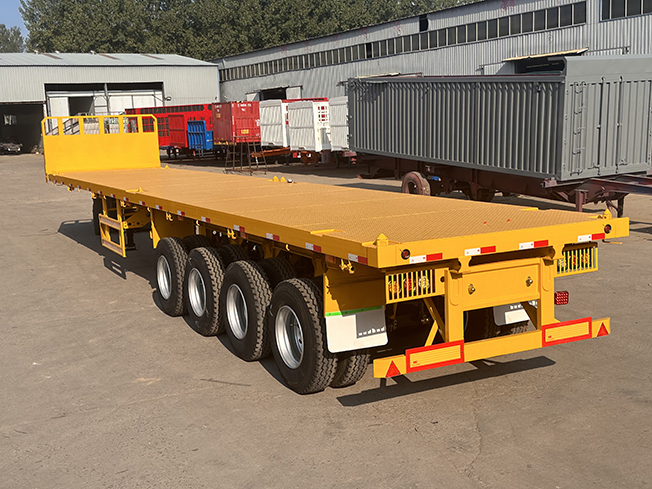
Evaluate Structure, Axles, and Route as One System
Trailer selection should connect payload distribution to axle configuration, fifth-wheel loading, kingpin load, tire ratings, and legal axle limits on the intended route. Do not use a nominal payload figure alone. Two steel loads with the same total mass can impose very different reactions because one is spread over the deck while another is concentrated in a small area.
Give the supplier a load sketch showing where each piece or coil sits. Then request a written review of the proposed configuration against the anticipated distribution and route constraints. The review should cover frame layout, suspension type, axle spacing, tire and wheel specification, landing gear, and coupling compatibility with the tractor. It should also distinguish equipment ratings from legal operating limits; the lower applicable limit governs the trip.
| Decision area | Questions to resolve before ordering | Why it matters for steel |
|---|---|---|
| Load distribution | Where will the heaviest pieces sit, and how does each planned layout affect axle loads? | Concentrated loads can create unsuitable axle or deck loading even when total cargo mass appears acceptable. |
| Route conditions | What are the bridge, axle, turning, road-surface, and site-access constraints? | Steel transport often combines highway travel with industrial yards and variable access roads. |
| Loading method | Will the trailer be crane-loaded, forklift-loaded, or loaded from the side? | The method affects usable deck space, point loads, access, and safe work procedures. |
| Tractor interface | Are fifth-wheel height, connections, and tractor axle ratings confirmed? | The trailer and tractor must be assessed as a combination, not separate purchases. |
Make Securement Capacity and Anchor Layout a Procurement Requirement
The restraint plan should be designed before the purchase order, particularly for coils and bundled products. Ask for the type, location, quantity, and rated working load limit of tie-down points, as well as the accessibility of those points when cargo is on the deck. Specify the intended chain, strap, binder, and accessory system separately; an anchor point alone does not prove that a complete securement arrangement is suitable.
For every typical load, prepare a restraint worksheet that identifies blocking, dunnage, coil containment equipment where required, direct and indirect tie-downs, edge protection, and inspection stops. The worksheet should be reviewed by competent personnel familiar with the cargo and the governing rules. This helps a logistics planning team compare competing trailer offers on the same criteria instead of comparing only price and nominal capacity.
Choose Practical Features for the Duty Cycle
A durable flat bed semi trailer solution is often defined by the details that support daily work. Consider the number and placement of stake pockets and rub rails, the need for a headboard or bulkhead, side access for operators, tool-storage requirements, mudguard and lighting protection, and ease of inspecting brakes, suspension, tires, and securement hardware. If corrosion exposure, coastal air, road salt, or long outdoor storage is expected, include a material and coating discussion in the specification review rather than assuming any one material is right for every operating environment.
Also define service expectations: inspection intervals, recommended spare parts, documentation supplied at delivery, and the escalation path if operating conditions change. For an export project, add packaging, receiving, and handover checks so that the delivered configuration can be verified against the approved requirement sheet.
Use a Comparable Supplier Evaluation Sheet
When reviewing quotations, require each supplier to respond to the same steel transport brief. A strong comparison includes verified drawings or specifications, declared ratings, load-distribution assumptions, anchor-point details, axle and suspension information, compatibility notes, warranty terms, and exclusions. Avoid treating photographs, generic catalog text, or unverified marketing claims as proof of suitability.
JINAN CMHAN TRUCK SALES CO.,LTD. supplies trucks, semi-trailers, and construction equipment for logistics, road construction, municipal, and industrial-goods transport. For a project inquiry, provide the cargo profile, route, tractor details, required loading method, preferred restraint approach, and destination requirements so the proposed configuration can be checked against the actual duty cycle.
Final Pre-Purchase Checklist
- Confirm the heaviest load, load geometry, and realistic load-distribution layouts.
- Confirm applicable mass, axle, dimensional, and cargo-securement requirements for every operating jurisdiction.
- Match deck length, deck construction, loading access, and protective materials to the actual cargo handling routine.
- Obtain a configuration review that addresses trailer, tractor, route, and loading arrangement together.
- Specify anchor locations, rated capacity, and the complete restraint system for typical steel loads.
- Compare suppliers using written evidence and final-configuration documentation, not headline claims alone.
- Plan daily inspections and operator training before the trailer enters service.
Conclusion
The most suitable flat bed semi trailer for steel transport is the one whose verified configuration supports your cargo geometry, securement process, loading method, tractor combination, and route constraints. Begin with a detailed operating brief, make cargo handling and restraint part of the specification, and validate the final design with qualified parties before purchase and dispatch. That approach produces a more defensible choice than selecting a flatbed trailer from capacity alone.