
 EN

How Does Aluminum Reduce Tank Truck Weight?
An aluminum tank truck can reduce tare mass because aluminum alloy has far lower density than carbon steel. That material difference matters, but it is not the whole answer. For a fleet planner, the practical question is not simply whether an aluminum tank truck is lighter. It is whether the finished vehicle, its tank design, chassis, equipment, cargo, route, and local legal limits work together.
From a fleet procurement perspective, a lighter shell can create room in the weight budget. Yet a useful decision starts with operating conditions: the liquid carried, the required volume, loading cycles, axle layout, road conditions, cleaning routine, and service support. Those details determine whether an aluminum tank truck is a sensible configuration rather than a material preference.
Why aluminum changes the weight calculation
At the raw-material level, aluminum is commonly cited at about 2.7 g/cm³, while carbon steel is around 7.8 g/cm³. In other words, aluminum is roughly one-third as dense. That does not mean an aluminum tank truck will weigh one-third as much as a steel tanker: tank wall thickness, baffles, reinforcements, manholes, piping, mounts, insulation, and chassis components all contribute to the completed vehicle mass.
Still, lower density gives designers a useful starting point. An aluminum alloy tank can be engineered with the stiffness, weld layout, and reinforcement appropriate to its service. The final saving is therefore a design outcome, not a universal percentage. Buyers should ask for a completed tare-weight estimate for the proposed configuration instead of applying a material-density ratio directly to the whole vehicle.
Where weight savings can occur
The tank barrel is usually the most visible source of savings, but an aluminum tank truck should be reviewed as a system. A lighter barrel may affect supports, subframe choices, mounting hardware, and the weight distribution across axles. Depending on the specification, the design team may also consider compartment arrangement, access equipment, pumping equipment, hose storage, and protective accessories.
That is the specification side; the next question is how it behaves in the daily routine. A fleet carrying a consistent liquid on established routes may value a repeatable tare weight and clear loading margin. A business handling different products or frequent route changes may need more emphasis on corrosion compatibility, cleaning procedures, compartment design, and axle loading. The right aluminum tank truck is the one whose weight reduction does not create an avoidable compromise elsewhere.
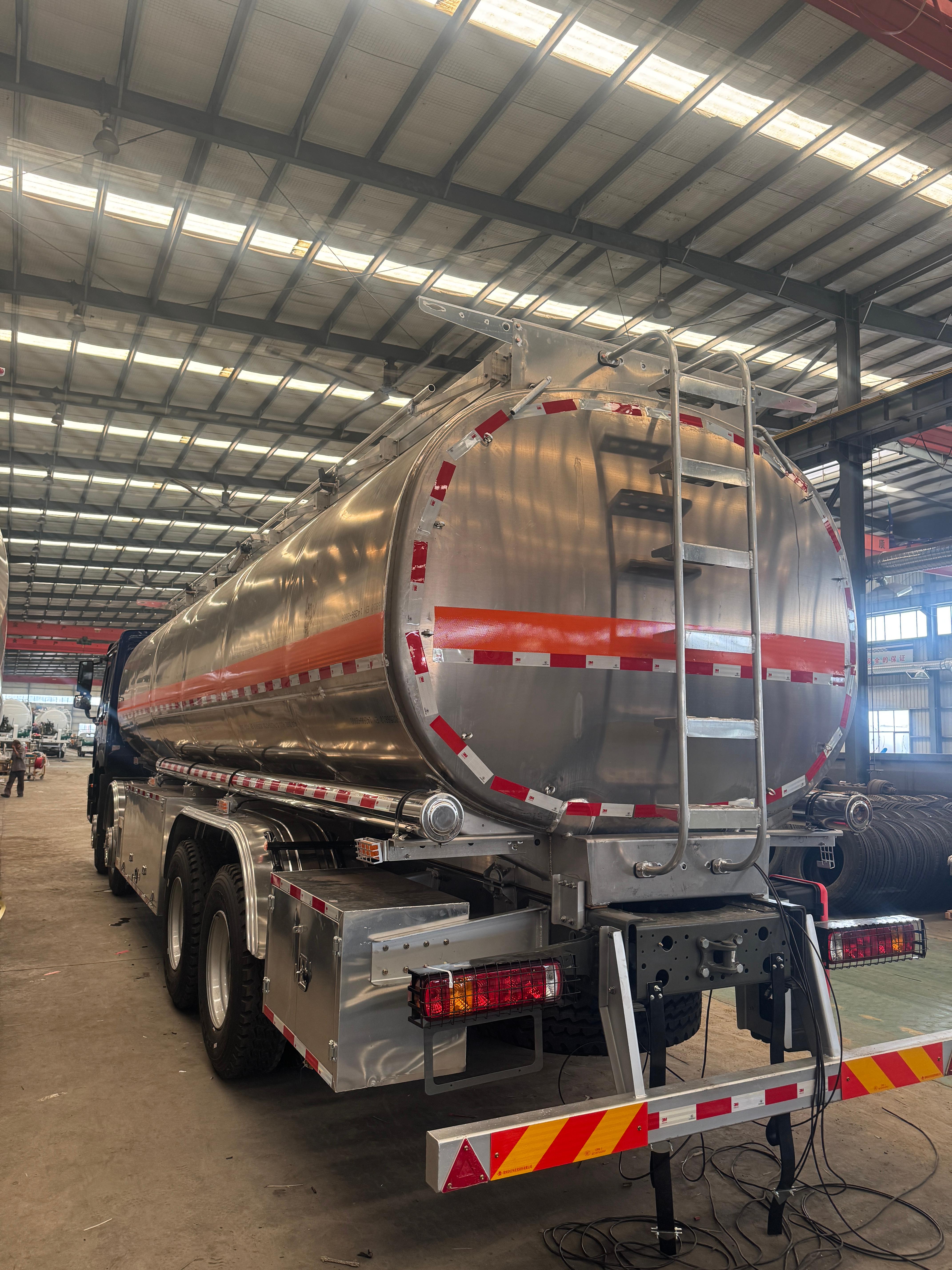 An aluminum tank structure can support a lower verified tare weight when the complete vehicle is engineered for its duty.
How lighter tare weight may affect payload capacity
In simple terms, payload capacity is the allowable loaded weight minus the empty vehicle weight. If an aluminum tank truck has a lower verified tare weight than a comparable design, it may leave more allowance for product payload. That potential is often the commercial reason to examine aluminum.
However, a lighter tanker does not automatically permit a larger legal load. Gross vehicle weight ratings, axle limits, bridge restrictions, tire ratings, chassis ratings, and regional rules still apply. The density of the cargo matters as well. A dense liquid can reach a legal weight limit before the tank reaches its volume limit, while a lighter product may be volume-limited. For this reason, payload capacity should be checked by weighing the complete proposed vehicle and modeling each intended cargo and compartment condition.
A useful checkpoint is payload distribution. Before deciding, relate it to the actual loading and unloading routine. For an aluminum tank truck, request an axle-load calculation with typical fill levels, not just an empty-weight figure. Partial loads, uneven compartment filling, pump placement, and accessories can change the distribution that operators see on a scale.
Weight is only one material-selection criterion
A lightweight tanker can support a useful weight budget, but material selection also depends on the carried medium and the operating environment. The compatibility of an aluminum alloy tank with a particular cargo should be reviewed by qualified engineering and compliance personnel. Temperature exposure, cleaning chemicals, external corrosion conditions, and repair practices may influence the specification.
Strength should be discussed with the same care. Aluminum and steel do not behave identically, and the correct plate, forming process, welding procedure, baffle arrangement, and reinforcement must match the intended duty cycle. It is better to compare approved completed designs than to assume that a single alloy label determines durability. If route conditions are severe or the load profile varies, configuration review becomes more important than a headline claim about an aluminum tank truck.
A practical comparison checklist
When evaluating an aluminum tank truck, use the same data set for every quotation:
- Completed tare weight, including chassis, tank, pump, hose reel, walkways, and safety equipment.
- Gross vehicle and axle-load calculations for full, partial, and expected cargo conditions.
- Tank volume, number of compartments, baffle design, and cargo-density assumptions.
- Material and cargo-compatibility review for the actual liquid and cleaning process.
- Required local approvals, inspection practices, and route-specific weight restrictions.
- Maintenance access, repair capability, and replacement-part availability in the operating region.
This comparison prevents a common error: treating an aluminum tank truck as a simple swap for a steel unit. The appropriate configuration is based on verified weights and operational constraints, not an assumed payload gain.
Questions to ask before specifying an aluminum tank truck
Start with three questions. What liquid will the vehicle carry? Which weight limit is most likely to constrain the route? What equipment must remain on the vehicle every day? The answers establish whether the expected aluminum tank weight reduction can translate into a useful operating margin.
Next, ask the supplier to identify what is included in the tare figure and to document the expected payload capacity by cargo condition. Clarify whether the proposal includes options such as an insulated body, pumping package, meter, hose reel, cabinet, or additional safety equipment. These items can materially change the completed mass of an aluminum tank truck.
Conclusion: verify the complete vehicle, not just the material
Aluminum reduces tank-truck weight because its lower density can reduce the mass of the tank structure. A well-designed aluminum tank truck may create more flexibility in the vehicle weight budget, which can be valuable where payload is limited by gross or axle weights. But the result depends on the whole specification.
Use verified tare weight, axle-load calculations, cargo compatibility, and route requirements to decide whether an aluminum tank truck fits the work. That disciplined process gives procurement teams a clearer basis for comparing a lightweight tanker with alternative tank materials.