 EN

HOWO Trucks Deliver Reliable Performance in Challenging Operating Environments.
When a fleet works on uneven haul roads, busy construction sites, or long regional routes, reliable performance is rarely the result of a badge alone. A HOWO truck has to be considered against its duty cycle, payload, route surface, service plan, and daily operating routine. From a fleet procurement planner’s perspective, that is the practical way to assess whether a HOWO configuration can support a demanding job.
A useful HOWO truck review starts with the work, not with a headline claim. A truck that fits repeated highway freight may require a different axle arrangement, body application, tire choice, and maintenance schedule from one assigned to quarry access roads or a changing construction vehicle workflow. JINAN CMHAN TRUCK SALES CO.,LTD. supplies trucks, semi-trailers, and construction equipment for logistics, road construction, municipal, and industrial-goods transport, so the selection conversation should begin with operating conditions that can be confirmed.
Why challenging environments change the HOWO selection process
Challenging work exposes small specification mismatches quickly. Road quality changes vibration and traction demands; repeated loading changes the importance of payload distribution; dust, water, and tight site access affect inspection routines. A HOWO truck can be a practical candidate for heavy-duty work when the final configuration is matched to those conditions, but a standard configuration may not suit every route.
For example, a mining truck application may involve short cycles, grades, loose surfaces, and frequent loading. A long-distance heavy transport assignment may instead emphasize route permissions, load securement, driver visibility, fuel planning, and planned service stops. Both can involve a HOWO vehicle, yet the questions that determine operating fit are different.
- What is the typical payload, including how it is loaded and distributed?
- How much of the route is paved, rough, steep, wet, or congested?
- What body or trailer interface is required for the actual job?
- Which inspection points must be reached during a normal shift?
- What parts, technician access, and downtime plan are available at the operating location?
These questions help turn a broad HOWO truck review into a checkable procurement decision. They also prevent a common error: treating a model name as proof that a vehicle is suitable for every load and site.
Match the HOWO duty cycle to the operating environment
Construction and municipal work
A construction vehicle often moves between prepared roads, loose material, temporary access lanes, and crowded loading zones. For a HOWO assignment in this environment, fleet teams should confirm turning requirements, ground conditions, the body-and-chassis relationship, and the rhythm of loading and unloading. That is the specification side; the next question is how the vehicle behaves in the daily routine.
Daily routines matter because site conditions can change faster than the nominal route plan. A useful checkpoint is inspection access; before deciding, relate it to the actual loading and unloading routine. Drivers and supervisors should be able to identify tire damage, fluid leaks, lighting issues, brake concerns, coupling condition, and visible fastener problems before they become dispatch disruptions.
Mining and off-road-adjacent work
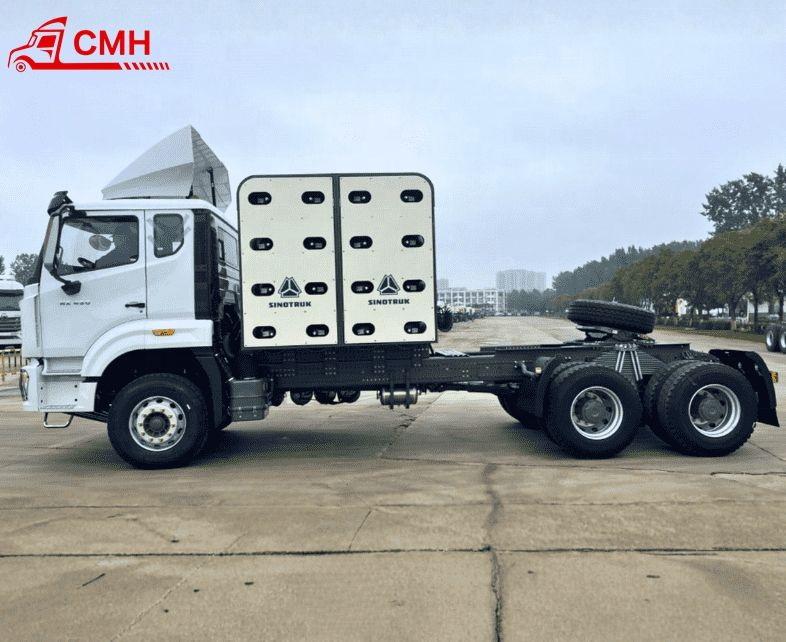
In a mining truck or quarry-support context, road conditions alter configuration priorities. Dust, gradients, surface irregularities, and repeated cycles can raise the value of a disciplined preventive-maintenance plan. A HOWO truck should therefore be evaluated with the expected payload, body type, route gradient, tire requirements, and service intervals documented for the specific task.
It is not simply a power or capacity issue; more precisely, daily exposure and maintenance practice both matter. Buyers should request and verify the final specification sheet, confirmed configuration record, and service-process details before making performance or suitability claims. This is a verification direction, not a confirmed performance claim for every HOWO model.
Long-haul and heavy transport work
For heavy transport, reliability is a system outcome. Route planning, vehicle availability, loading discipline, maintenance visibility, and driver checks all influence whether a schedule can be maintained. A HOWO truck may be considered alongside the trailer, cargo dimensions, axle and route restrictions, and required load-restraint method. First clarify the task, then compare configurations, and only then discuss price.
General cargo-securement guidance emphasizes preventing articles from shifting or falling during transport. Local laws and project requirements must be checked, but the operating lesson is broadly useful: load security, weight distribution, and the condition of restraint equipment belong in the dispatch plan, not only in a post-incident review.
Reliability depends on inspection and service access
One reason fleet buyers revisit a HOWO truck review after purchase is that daily serviceability becomes visible only in operation. Before selecting a HOWO configuration, ask who will carry out routine checks, where the truck will be serviced, and how defects will be recorded and escalated. A lower initial price does not by itself answer the operating-cost question.
A practical pre-dispatch routine should cover tires, brakes, lights, fluids, safety equipment, and visible defects, then record issues for follow-up. The exact checklist must follow local rules and the vehicle documentation, but a consistent process can help teams separate observed symptoms from presumed causes. That distinction improves communication with technicians and helps avoid replacing components based only on assumptions.
A practical HOWO evaluation checklist
- Define the work: Record payload range, cargo behavior, shift length, loading method, and route conditions.
- Confirm the configuration: Verify the proposed HOWO chassis, drive arrangement, body interface, and any task-specific equipment against the final specification.
- Review maintenance access: Identify routine inspection points, planned service location, parts identification process, and escalation contacts.
- Plan the operation: For heavy transport, document load securement, route constraints, and dispatch checks; for construction or mining work, document site controls and surface conditions.
- Capture feedback: Update the operating checklist when the task, route, payload, or site conditions change.
This sequence gives a more useful answer than asking whether one HOWO truck is the right choice for every task. The relevant technical question is whether the verified configuration suits the actual environment.
Make reliability a verified operating plan
A well-matched HOWO truck can support demanding logistics, road-construction, municipal, and industrial transport tasks when the buyer aligns configuration with duty cycle and maintains a repeatable inspection routine. For a HOWO purchase discussion, prepare the route profile, payload information, body or trailer requirement, service location, and destination conditions. JINAN CMHAN TRUCK SALES CO.,LTD. can use that information to support a focused configuration conversation rather than a generic recommendation.
The strongest HOWO truck review is therefore not a promise of universal performance. It is a disciplined comparison of task requirements, confirmed specifications, maintenance access, and operating controls. If those elements are clear, a HOWO evaluation becomes more reliable, more transparent, and more relevant to the job ahead.